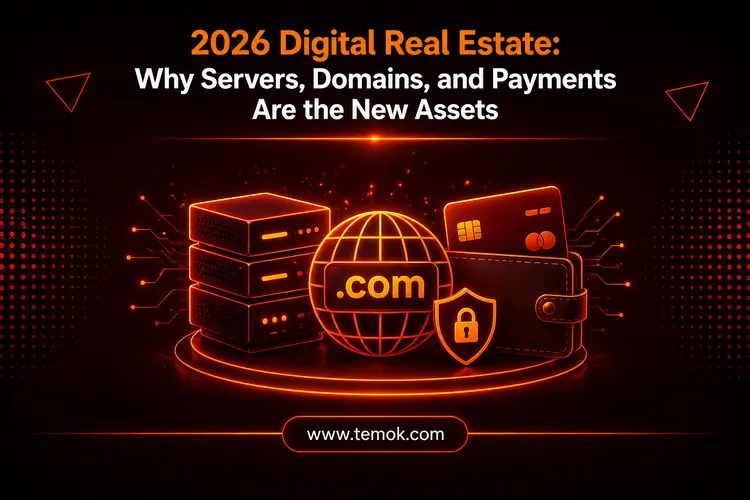

Let’s be honest: we officially stopped thinking of the internet as some abstract “cloud” a long time ago. In 2026, it is a very tangible space where every click triggers a massive machine spread across different continents. When you type a name into your browser, you aren’t just opening a page-you’re renting a piece of someone else’s processing power. In this landscape, 2026 digital real estate isn’t just a metaphor; it’s the literal ground you stand on.
From creators building their digital presence to founders scaling startups, understanding the iron, the address, and the money is what separates real digital assets from temporary setups.
The Iron Heart: Why Your Server Choice is a Litmus Test
A server is, essentially, a computer that never sleeps. It works 24/7 to ensure your data is accessible. According to Wikipedia, server capacity is currently the fastest-growing resource on the planet. But in 2026, the market is flooded with “synthetic noise”-AI-generated content and bot traffic that clogs up cheap pipelines.
Cloud infrastructure has democratized the web, allowing a two-person startup to have the same response speed as a massive corporation. But “theoretical” speed is one thing; actual performance is another. When everyone uses the same shared cloud buckets, performance drops. This is why 2026 digital real estate starts with the hardware.
The Power of the “Iron”
If your business depends on real-time data, you eventually hit a wall with shared hosting. This is where dedicated server rental becomes the ultimate power move:
- Performance: No “noisy neighbors” stealing your CPU cycles.
- Security: You control the physical gates and the encryption layers.
- Reliability: In 2026, a 100ms delay isn’t just an annoyance; it’s a lost customer.
Investing in a dedicated server is like buying the land under your house rather than renting a room. It gives you the “right to build” without asking for permission.
The Name Game: Why Your Domain is Your Primary Asset
If the server is the land, the domain is the deed. We’ve moved far beyond the days when a domain was just a technical necessity. Today, domain name registration directly affects how Google perceives your brand. It is how you’ll be remembered (or forgotten).
Choosing Your Address in the Chaos
A few tips from those who’ve learned the hard way:
- The “Wine Test”: If the name is hard to pronounce after a glass of wine, it’s a bad name.
- No Hyphens: People hate typing them, especially on mobile. If your domain has a dash, you’re losing traffic to typos.
- The Trust Factor: A sketchy domain looks like a sketchy alleyway. People won’t enter their credit card details if the address doesn’t feel premium.
In the world of 2026 digital real estate, a clean, short domain is worth more than your logo. The logo can be redesigned; the domain is your legacy and your SEO foundation.
The Money Wars: From Credit Cards to Crypto-Anarchy
Ten years ago, paying for hosting in the US while sitting in Eastern Europe was a quest. Today, the rise of online cryptocurrency payments has finally decoupled business from geography. We have such a spectrum of tools that it can be overwhelming, but each has its own “vibe.”
| Payment Method | Speed | Privacy | Best For? |
|---|---|---|---|
| Credit Card | Instant | Low | Everyday Subscriptions |
| PayPal | Instant | Medium | Secure purchases in Western markets |
| Bank Transfer | 1-3 Days | High | Serious B2B contracts |
| Crypto | From 10 mins | Maximum | Those who value anonymity and freedom |
Thanks to crypto, digital borders have effectively vanished. You can live anywhere and work with anyone without asking for your bank’s permission. This financial sovereignty is the fuel that powers the modern ecosystem.
Visualizing Ideas: The Era of Cloud-Based Content

Once the server is configured and the domain is “claimed,” you need to engage your audience. Modern users want dynamics. Video is the only language everyone speaks. In the past, professional editing required a computer that cost as much as a private jet.Thankfully, those days are gone. Now, anyone can create high-end content directly in the cloud. You’re using the resources of remote servers, so your old laptop won’t even break a sweat. If you need to cut a clip on the fly while riding the subway, the Clideo Video Editor comes to the rescue.This makes creativity mobile-you’re no longer tethered to a desk. You are essentially using the cloud infrastructure as an external brain, allowing you to produce 4K content from a smartphone.
Security: Locking the Doors in a Post-Privacy World
You wouldn’t buy a mansion and leave the front door wide open. In the realm of 2026 digital real estate, security is the “insurance policy” you cannot afford to skip. The threats today are AI-driven botnets capable of testing millions of passwords a second.
- Anycast DNS: Distributes your site’s “address book” across the world so a DDoS attack can’t knock you offline.
- Hardware Keys: Using physical keys for your domain registrar prevents 99% of hijacking attempts.
- SSL/TLS: In 2026, non-encrypted sites are essentially invisible to search engines.
What Awaits Us Tomorrow?
We are moving rapidly toward Web 3.0-a world where servers will be distributed across millions of private devices, and domains will be part of your crypto wallet. Paying via Bank Transfer will remain for conservatives, while most processes will be handled by smart contracts.
Fun Fact: The first domain was registered back in 1985 (symbolics.com). Since then, the world has changed beyond recognition, but the need for “your own place” on the net has only grown. We are now seeing the rise of:
- AI Estates: Automated systems that find the cheapest server space in real-time.
- NFT Domains: Addresses that you own forever, with no renewal fees.
- AI Servers: Servers powered entirely by underutilized renewable energy.
- Creator-Owned Assets: With tools like a browser video editor, individuals can instantly create and publish high-value content and scale digital assets without depending on heavy infrastructure.
Conclusion
Technology, servers, and finance are not separate worlds-they are one living organism. Understanding how they work together gives you an incredible advantage. Whether you’re just paying for a subscription via Credit Card or building a complex IT infrastructure, remember: technology should serve the idea, not the other way around.
The future is already here, and it’s accessible through a link in your browser. Choose your 2026 digital real estate wisely; your address and your “iron” are the only things that truly belong to you in the digital age. Welcome to the neighborhood.