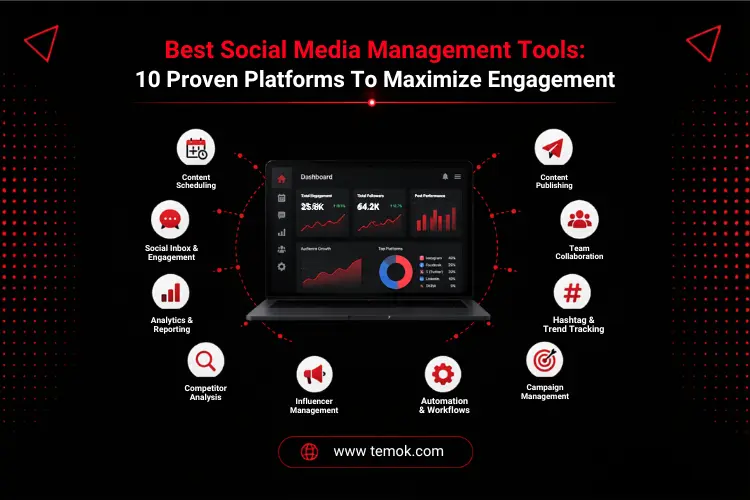

Best social media management tools enable businesses to plan content, automate publishing, analyze audience interaction, measure performance metrics, and manage various social networks from a single dashboard. In 2026, Hootsuite, Buffer, Sprout Social, SocialPilot, and Later are still among the most trusted solutions for increasing social media engagement and simplifying everyday marketing activities.
Key Takeaways
- Best overall tool: Hootsuite allows you to have comprehensive content scheduling, analytics, and enterprise performance tracking.
- Best for small businesses: Buffer for simplicity, low cost, and ease of use.
- Best for agencies: Sprout Social provides client management and thorough reporting.
- Best Free Tool: Buffer’s free plan provides strong scheduling possibilities.
- Best AI-Powered Tool: Later combines AI content to help with visual content planning.
- Automation: Social media automation with the appropriate platform saves the typical marketing team 6 to 10 hours a week on manual publishing and reporting duties.
Introduction
Managing social media used to be simple before.
You may write a post, respond to a few comments, and then get on with your day. Today, things are totally different.
Businesses should be active on Facebook, Instagram, LinkedIn, X, TikTok, Pinterest, and other developing platforms at the same time. Customers want prompt replies. Competitors create and publish content around the clock. Algorithms promote consistency while punishing inactivity.
Many firms no longer face the difficulty of producing content. The actual problem is to manage everything efficiently.
That is where the best social media management tools become integral.
Instead of having to log into several accounts every day, these tools let you handle content scheduling, audience interaction, engagement tracking, campaign analytics, and social media reporting all in one spot.
If you are a startup entrepreneur, digital marketer, content strategist, eCommerce company, or agency owner, the correct social media management software may save you hours every week while also allowing you to create closer relationships with your audience.
In this detailed blog, we’ll look at the best social media platform management tools available in 2026, compare their features, and help you select the best solution for your company’s social media engagement needs.
So, keep reading and exploring to get to know more about the 10 best social media management software.
What Are Social Media Management Tools?
Social media management tools are the tools that let you actively schedule posts, monitor mentions, replies to threads or comments, and do performance tracking across multiple social media platforms using only one dashboard.
A modern social media management platform usually integrates numerous features, including:
- Content scheduling
- Automated publishing
- Social media analytics
- Audience engagement tracking
- Social media reporting
- Team collaboration
- Approval workflows
- Social media automation
- Multi-user management
The main purpose of social media management software is to improve the efficiency and measurable performance of social media platforms.
For example, a marketing team may use a content calendar to prepare a whole month’s worth of content, monitor audience response in real time, and examine engagement metrics without having to jump between social networks.
As social media evolves, organizations are increasingly relying on social media marketing tools to stay organized, increase consistency, and optimize ROI.
Let’s now discuss the importance of social media management before we mention 10 best social media management tools.
Why Social Media Management Tools Matter?
Many businesses underestimate how much effort it takes to maintain a good social media presence.
Without suitable processes, teams frequently have inconsistent posting, lost opportunities, and poor campaign success.
The best social media management tools address these issues. Here are the reasons why social media management tools matter in 2026:
Save Time Through Social Media Automation
It takes hours to post across five different social media platforms every day manually. Social media automation using scheduling tools significantly reduces that time. You batch your content, schedule it for the best times, and let the platform manage the publication while you focus on strategy.
Instead of manually posting each post, digital marketers may utilize social media scheduling tools to prepare weeks or even plenty of months’ worth of content in advance.
Features like post scheduling and automated publishing enable teams to concentrate on strategy rather than monotonous duties.
Improve Audience Engagement
Publishing content is just one aspect of social media success.
The true value derives from significant audience involvement.
Most social media software for businesses has engagement monitoring abilities that allow organizations to reply to comments, messages, and mentions more rapidly.
Faster reaction times frequently result in better connections and increased social media participation.
When consumers feel heard, they are more inclined to trust and promote your company.
Manage Multiple Platforms
Modern brands rarely use a single network.
Managing Facebook, Instagram, LinkedIn, TikTok, Pinterest, and X individually may rapidly become daunting.
A compiled social media management software enables users to manage all social accounts from a single dashboard, increasing productivity and decreasing errors.
This method streamlines the social media management platform while ensuring uniformity across platforms.
Track Performance Metrics
Guesswork should never be the basis for success on social media.
The best social media management tools include comprehensive social media analytics and performance monitoring features.
Companies can keep an eye on:
- Reach
- Engagement metrics
- Click-through rates
- Follower growth
- Campaign performance
- Conversion trends
Marketers may use this information to determine what is effective and what requires improvement.
Strengthen Brand Consistency
One of the most crucial elements of success on social media is consistency.
Businesses may keep a consistent publication schedule by utilizing content scheduling and content calendar tools.
Trust develops organically over time when followers often see quality content.
Additionally, a consistent brand voice enhances trust and awareness across all media.
Also Read: How To Make a Social Media App: Smart Strategies For Modern App Development
How We Selected the Best Social Media Management Tools?
Not all social media management software produces similar outcomes. Some people focus on scheduling. Others specialize in engagement analytics, reporting, and agency management tools for better multi-user management.
To choose the best social media management tools for 2026, we evaluated each platform against six criteria before including it on this list.
- Features: We focused on systems that provide extensive functionality such as scheduling, analytics, reporting, audience engagement, content planning, and collaboration tools.
- Ease of Use: We tested if a non-technical person can benefit from the platform without weeks of training.
- Integrations: we evaluated if the social platforms operate with the social networks and third-party technologies that your team already uses or not.
- Analytics: Strong engagement analytics and campaign analytics capabilities are essential for measuring success. We tested if engagement analytics go beyond surface-level metrics to provide insights that help make decisions.
- Pricing: We also tested whether the pricing structure was straightforward and proportionate to the value provided.
- Scalability: We tested whether the platform supports a business’s growth from single creator to agency to enterprise without requiring a difficult migration.
10 Best Social Media Management Tools
Let’s now discuss the best social media management platforms, including their features, Pros, cons, and best use cases.
1. Hootsuite
Hootsuite has been one of the most well-known names in the best social media marketing tools since 2008. In 2026, it remains the best option for enterprise teams handling complex, multi-platform operations.

Its OwlyWriter AI tool creates platform-optimized captions and drives an AI content calendar that recommends posting times based on audience interaction trends.
The social media scheduling software supports a variety of social networks and has advanced scheduling, monitoring, and reporting features. That is why it is in top of our list of 10 best social media management tools.
Hootsuite is primarily targeted at enterprises that can turn social interaction into income. The cheapest package has doubled in price due to the addition of AI features.
Key Features:
- Advanced social media scheduling tools
- Unified social inbox
- Social media analytics dashboard
- Team collaboration features
- Approval workflows
- Engagement tracking
- Content calendar management
Pros:
- Supports several social networks
- Excellent reporting capabilities
- Strong collaborative tools
- Enterprise-grade functionality
Cons:
- More costly than some competitors
- It may feel complex to use for beginners
Best For:
Large businesses, enterprise teams, and organizations managing multiple brands.
2. Buffer
Buffer is among the longest-running social media applications for scheduling posts, and it has undergone several tweaks, shifts, and modifications to keep up with the times. It now supports Facebook, X (Formerly Twitter), LinkedIn, Instagram, TikTok, YouTube, Threads, Pinterest, and Google Business Profiles.

Furthermore, free users may link maximum 3 social accounts, including Facebook Business Pages and groups, but you can only schedule 10 posts per channel.
Its per-channel pricing scheme begins at $6 per Month per channel, and its free plan includes three channels with no credit card necessary.
Key Features:
- Easy content scheduling
- Post scheduling automation
- Social media analytics
- Content calendar
- Multi-platform publishing
- Team collaboration support
Pros:
- User-friendly interface
- Prices are affordable
- Reliable scheduling tools
- Strong free plan
Cons:
- Limited advanced reporting
- Fewer enterprise features
Best For:
Small companies, freelancers, and entrepreneurs looking for an affordable social media scheduler.
3. Sprout Social
Sprout Social is the top choice for teams that want the best social media management tools to act as the focal point of their whole social operation.

Its Trellis AI feature set integrates publishing, social listening, Smart Inbox, sentiment analysis, and reporting into a single solution.
Key Features:
- Advanced social media reporting
- Comprehensive engagement analytics
- Social listening capabilities
- Team collaboration
- CRM integration
- Monitoring audience interaction
Pros:
- Dead simple scheduling
- Exceptional reporting features
- Excellent user experience
- Decent free tier
- Powerful social listening tools
- Strong customer support
Cons:
- Premium pricing
- It may surpass the demands of small enterprises.
Best For:
Marketing agencies, larger teams, and businesses that focus on data-driven growth.
4. SocialPilot
SocialPilot is becoming increasingly popular among organizations seeking a cheap alternative to enterprise-focused platforms.

It strikes a favorable balance between usefulness and affordability.
The platform offers scheduling, community engagement, analytics, collaboration capabilities, and agency management tools without the high cost associated with larger rivals.
Key Features:
- Bulk scheduling
- Automated publishing
- Social media reporting
- Team management
- Client management tools
- Performance tracking
Pros:
- Competitive price
- Strong agency features
- Easy content scheduling
- Supports multiple accounts
Cons:
- The interface is not as slick as premium rivals
- Analytics could be more advanced
Best For:
Agencies, consultants, and growing businesses that focus on managing multiple clients.
5. Later
Later began as an Instagram-focused platform, but has since grown into an inclusive social media management platform. Its visual-first approach appeals to brands that rely heavily on images and video content for marketing.

The platform also includes AI-powered features to help with content planning and optimization which makes it one of the best social media management tools.
Key Features:
- Visual content calendar
- AI content assistance
- Social media scheduling software
- Link-in-bio tools
- Engagement tracking
- Multi-platform publishing
Pros:
- Excellent graphic planning tools
- Strong Instagram support
- User-friendly design
- Useful AI features
Cons:
- The analytics are not as deep as those of other rivals.
- Certain sophisticated features require a higher-tier plan.
Best For:
Content creators, influencers, eCommerce brands, and visually focused businesses.
6. Agorapulse
Agorapulse is a good mid-market alternative that outperforms other products in its price range in terms of feature richness and simplicity of use.

Its social inbox and community management features are especially popular among social media administrators who deal with large numbers of comments and messages on a regular basis.
Key Features:
- Unified social inbox
- Social media scheduling tools
- Social listening capabilities
- Engagement analytics
- Free plan for 3 social profiles with 10 scheduled posts
- Team collaboration features
- Social media reporting
Pros:
- Excellent inbox management
- Strong reporting ability
- Simple to use UI
- Excellent client assistance
Cons:
- Prices are higher for larger teams
- Some advanced functions require a premium plan
Best For:
Brands focused on customer engagement, community management, and relationship building.
Also Read: IT Automation Tools: Integrating AI to Supercharge IT Processes
7. Sendible
Sendible is designed primarily for agencies, which is evident in how the platform handles client administration, social media reporting, and white-label options.

It has a well-deserved reputation for being one of the cleanest multi-client management solutions available at this pricing bracket.
Key Features:
- Client management tools
- Approval workflows
- Content scheduling
- Social media analytics
- Social listening
- Team collaboration
Pros:
- Developed for agencies
- Excellent reporting options
- Flexible publishing tools
- Strong cooperation features
Cons:
- The interface can feel overwhelming initially
- Steep learning curve for beginners
Best For:
Marketing agencies and businesses that manage multiple brands.
8. Loomly
Loomly focuses mainly on content planning and collaboration. It serves as both a social media scheduling tool and a content management platform.

Loomly provides a structured framework for teams that struggle to organize campaigns, allowing them to easily manage ideas, drafts, approvals, and publication dates.
Its user-friendly layout appeals to organizations seeking simplicity without losing capability which make it one of the best social media management tools.
Key Features:
- Content calendar
- Approval workflows
- Automated publishing
- Team collaboration
- Post optimization suggestions
- Campaign management
Pros:
- Easy to use
- Excellent planning tools
- Strong cooperation features
- Clean interface
Cons:
- Limited sophisticated analytics
- Fewer social listening skills
Best For:
Marketing teams focused on content creation and approval processes.
9. Zoho Social
Zoho Social is an all-in-one social media management solution that stands out for its strong integration with the larger Zoho business environment.

For small businesses that currently use Zoho CRM or Zoho Desk, this platform provides a simple approach to link social media activity directly to Customer Relationship Management (CRM), resulting in a consolidated picture of client interactions.
Key Features:
- Social media scheduling software
- Performance tracking
- Social media reporting
- Team collaboration
- CRM integration
- Content planning
Pros:
- Prices are affordable
- Strong CRM integration
- User-friendly dashboard
- Reliable scheduling tools
Cons:
- Limited enterprise features
- Analytics are less sophisticated than premium competitors
Best For:
Small businesses and organizations are already using the Zoho ecosystem.
10. Metricool
Metricool has also developed considerably as one of the best social media management tools in 2026, serving as an appealing option to more expensive analytics-heavy systems.

Its strengths include performance tracking and engagement analytics, as well as competition data, all at a price that most small and medium-sized enterprises can afford.
Key Features:
- Engagement tracking
- Social media analytics
- Campaign analytics
- Performance tracking
- Competitor monitoring
- Automated reports
Pros:
- Strong analytics platform
- Prices are affordable
- Simple-to-read reports
- Excellent performance insights
Cons:
- Less focus on teamwork
- Scheduling features are less advanced than those of other competitors
Best For:
Data-driven marketers and organizations seeking deeper insights into campaign effectiveness.
Social Media Management Tools Comparison Table
Let’s now take a look at the 10 best social media management tools comparison table so that you can have a quick idea of what each of the tools is offering.
| Tool | Best For | Scheduling | Analytics | Team Collaboration | Starting Price/Month | Free Trial |
|---|---|---|---|---|---|---|
| Hootsuite | Enterprises | Excellent | Excellent | Advanced | From $99 | Yes |
| Buffer | Small Businesses | Great | Good | Basic | From $6 | Yes |
| Sprout Social | Agencies, Enterprises | Excellent | Excellent | Advanced | From $199 | Yes |
| SocialPilot | Budget Agencies | Great | Good | Good | From $30 | Yes |
| Later | Visual Creators | Great | Good | Basic | From $25 | Yes |
| Agorapulse | Mid-Market Teams | Great | Great | Good | From $99 | Yes |
| Sendible | Agencies | Good | Good | Good | From $29 | Yes |
| Loomly | Brand Teams | Great | Good | Excellent | From $65 | Yes |
| Zoho Social | Zoho Users | Good | Good | Good | From $15 | Yes |
| Metricool | Analytics-Focused Teams | Good | Excellent | Basic | From $25 | Yes |
Important Features to Look For in Social Media Management Tools

Comparing pricing is only one aspect of choosing one of the best social media management tools. The best social media software should help you develop over time while simplifying day-to-day operations.
Here are the key features you must look for in social media management software:
Content Scheduling
Content scheduling is the cornerstone. Look for bulk scheduling, repeating post options, queue management, and the flexibility to adapt postings to each platform separately rather than posting the same information everywhere. It must act like a content strategist.
Social Media Analytics
Social media analytics should include more than likes and followers. Look for engagement analytics by post type, platform, and time of day, as well as audience demographics and long-term content performance patterns.
Team Collaboration
As your team expands, features that improve team cooperation become increasingly important. Look for role-based access, procedures for content approval, internal comments on drafts, and the ability to send tasks or messages to individual team members.
Social Listening
Social media automation for monitoring entails the technology tracking brand mentions, relevant keywords, and competitor activity, even when you are not actively monitoring. This is how you identify a problem early on or locate a worthwhile discourse to join.
Content Calendar
A visual content calendar displays your scheduled content across all platforms at a single glance. The best social media management tools enable you to reschedule articles by dragging and dropping them, quickly spot content gaps, and graphically plan campaigns.
AI Content Assistance
Every important social media management software in 2026 will get some AI help. Look for caption creation, best publishing time recommendations, and AI-powered content ideas that save time rather than delivering generic results.
Reporting Dashboards
Social media reporting dashboards should be customizable, exportable, and shareable with customers or stakeholders who do not use the platform. White-label reporting is vital for organizations that offer outcomes to customers.
Best Social Media Management Tools by Use Case
Not all businesses require the same solution. The best social media marketing software is generally determined by the size of the firm, its goals, and the resources available. Here are the best social media management tools by use case:
| Use Case | Recommended Tool |
|---|---|
| Budget-Friendly | SocialPilot |
| Small Business | Buffer |
| Agencies | SocialPilot or Sendible |
| Enterprise | Hootsuite or Sprout Social |
| Visual Content Creators | Later |
| Analytics-Focused Teams | Metricool |
| Zoho CRM Users | Zoho Social |
| Brand Approval Workflows | Loomly |
| Community-Heavy Brands | Agorapulse |
For instance, a small local firm could profit from Buffer’s simplicity, but a major firm handling many clients could need Sprout Social’s thorough reporting and teamwork features.
How Social Media Management Tools Maximize Engagement?
The fundamental objective of social media is not to publish content. It is establishing meaningful connections with others.
The best social media management tools help achieve this goal in a variety of ways, such as:
- Consistent Posting: Regular posting ensures that companies remain visible and relevant. Scheduling solutions guarantee that content reaches consumers on a continuous basis, whether on weekends, holidays, or during peak periods.
- Audience Insights: Engagement analytics highlight the most popular subjects, formats, and posting times. This information enables firms to generate more effective content.
- Better response times: Unified inboxes enable teams to reply to comments and messages more quickly. Quick replies frequently increase customer satisfaction and inspire more audience engagement.
- Performance Optimization: Tracking engagement metrics enables social media marketers to identify successful campaigns and optimize future plans. These advances accumulate over time, yielding greater effects.
- Campaign Tracking: Campaign analytics reveal what is working and where changes are required. This helps firms to manage resources better and maximize profits.
Common Social Media Management Mistakes to Avoid

Common Social Media Management Mistakes to Avoid
Even with the best social media management tools, mistakes can block success. Here are some of the mistakes every business must avoid while doing social media management:
- Posting without reviewing analytics. If you schedule content but never monitor its performance, you are creating without learning. Review performance tracking data at least once a week.
- Ignoring audience data. Your social media analytics reveal who your target audience is, when they are online, and what they care about. Ignoring that data and publishing solely on personal choice will result in persistent underperformance.
- Over-automating audience interaction. Social media automation is great for posting, but reactions to comments and direct messages should still be personal. Automated responses that lack context soon irritate listeners.
- Inconsistent publishing. Using a social media scheduler to publish social media content every day for two weeks and then staying black for a month reduces your algorithmic reach. In 2026, consistency will be more important than frequency of posts.
- Tracking vanity metrics only. Follower counts and likes are easy to measure, but they are rarely the most essential metrics. Focus on engagement metrics that represent actual audience activity, such as saves, shares, click-through rates, and profile visits using the best social media management tools.
Future Trends in Social Media Management
The social media ecosystem is constantly evolving, with considerable changes expected in the coming years. Here are some of the social media management future trends you must know:
AI-powered Content Creation
Social media marketing software with AI support is becoming the standard. The next phase is AI, which creates whole content calendars, recommends campaign topics based on competition data, and automatically adjusts content to each platform’s tone and structure.
Predictive analytics
Engagement tracking is transitioning from descriptive (what occurred) to predictive (what will perform well next). Tools are now recommending certain content categories and publishing times based on predictive algorithms educated on your past data.
Social Commerce Integration
As the number of people shopping directly from social media platforms increases, social media platform management software is introducing commerce capabilities that integrate inventory, product tags, and purchase tracking directly into the management dashboard.
Automated Engagement
Beyond scheduling, automation is extending to include smart answers, comment moderation, and proactive participation with relevant conversations occurring outside of your own profile. This is the next frontier in community management at scale.
Cross-Platform Management
The number of relevant platforms is continuing to increase. The best social media management tools for businesses that swiftly integrate Threads, Bluesky, and future platforms will have a considerable edge over slower-moving competitors in this market.
FAQs (Frequently Asked Questions)
What Are Social Media Management Tools?
Social media management tools are software solutions that enable organizations to schedule content, track interaction, assess performance, and manage many social media accounts from a single platform.
Which Social Media Management Tool Is Best?
Hootsuite is frequently regarded as the finest overall solution, with Buffer great for small firms and Sprout Social a popular pick for agencies.
How Do Social Media Management Tools Work?
They integrate various social accounts into a unified dashboard from which users can plan content, measure performance, manage audience interactions, and produce reports.
Are Social Media Management Tools Worth It?
Yes, if you manage several profiles, conduct ad campaigns, or collaborate with others, social media management tools are well worth the investment.
What Features Should Businesses Look For?
Businesses should prioritize content scheduling, social media analytics, reporting dashboards, collaboration tools, social listening, and AI-powered assistance.
Which Platform Is Best For Agencies?
Sprout Social and Sendible are among the best social media tools for businesses since they include extensive reporting, client management, and collaboration capabilities.
Can Social Media Management Tools Improve Engagement?
Yes. Consistent post scheduling ensures that you appear consistently, which the best social media management tools reward with increased reach. Engagement statistics reveal which content generates the greatest audience engagement, allowing you to tailor your strategy based on real facts.
Do These Tools Support Multiple Social Networks?
Yes. Most social media management tools support the major networks, such as Facebook, Instagram, LinkedIn, TikTok, Pinterest, X (Twitter), and YouTube. Hootsuite leads with over 35 network connections. Metricool differentiates itself since it also supports Reddit, Bluesky, and Google Ads.
Are There Free Social Media Management Tools Available?
Indeed. Metricool, Buffer, and other platforms offer free plans with limited features that could help small businesses and individuals.
Conclusion
In 2026, good social media management will demand more than just inventiveness. It calls for speed, uniformity, data-driven decision-making, and meaningful audience connection.
The best social media management tools enable organizations to streamline everyday operations while increasing engagement across numerous platforms. On one platform, they combine content scheduling, social media analytics, automatic posting, community management, performance tracking, and teamwork.
For most businesses, Hootsuite remains the best all-around option. Small companies will benefit from Buffer’s simplicity and cost. Agencies seeking sophisticated reporting and collaboration should seriously consider Sprout Social. Later’s visual-first strategy can assist content producers, while budget-conscious corporations may find SocialPilot to be exceptionally valuable.
So, just pick the right social media management software and utilize it appropriately. Moreover, let the real facts from your social media analytics tell you to take the next step. What sets companies with real audience involvement apart from those still wondering why they only get three likes is publishing, measuring, and improving in a cycle.