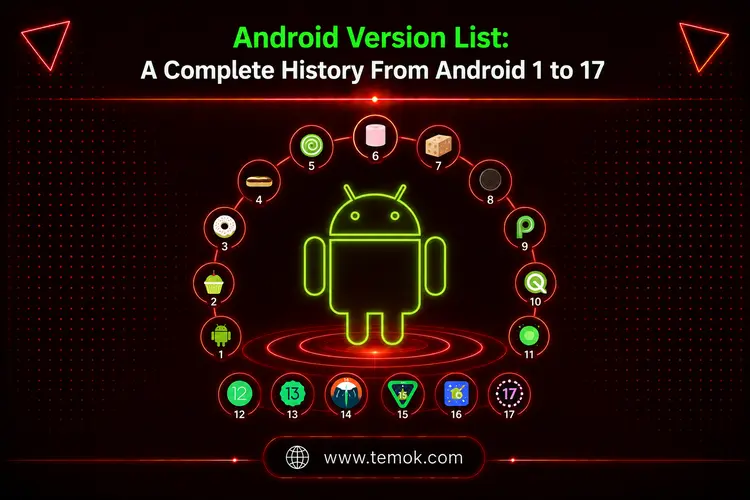

Android is undoubtedly the most popular and widely used mobile OS in the world. It’s been 18 years since its first commercial launch in 2008. We have seen significant improvements after every version release; each comes with new features, better performance, stronger security, and always a better user experience. That is why the Android operating system is running on over 3 billion active devices globally. In this blog, you will get to know about the Android version list from the beginning to the latest running version, with its brief history, functionality, and features.
Android 1.0 to Android 17: A Quick Overview of Major Android Releases
In the following Android version table, you can get a quick overview of the major Android releases over the years, including their codenames, year, API level, and major innovations developers have made over the years. Here is a quick Android version list table for your basic understanding:
| Android Version | Codename | API Level | Release Year | Major Innovation |
|---|---|---|---|---|
| Android 1.0 | Alpha | API 1 | 2008 | Very first Android release with Gmail, Maps, YouTube, and Android Market |
| Android 1.1 | Petit Four (Beta) | API 2 | 2009 | Stability improvements and API enhancements |
| Android 1.5 | Cupcake | API 3 | 2009 | On-screen keyboard and home-screen widgets |
| Android 1.6 | Donut | API 4 | 2009 | Support for multiple screen dimensions and Quick Search Box |
| Android 2.0 | Eclair | API 5 | 2009 | Google Maps Navigation, live screen wallpapers, multiple accounts |
| Android 2.2 | Froyo | API 8 | 2010 | Wi-Fi hotspot provisioning and major performance boost |
| Android 2.3 | Gingerbread | API 9 | 2010 | NFC support and upgraded mobile gaming APIs |
| Android 3.0 | Honeycomb | API 11 | 2011 | First Android version designed precisely for tablets |
| Android 4.0 | Ice Cream Sandwich | API 14 | 2011 | Integrated smartphone & tablet experience |
| Android 4.1 | Jelly Bean | API 16 | 2012 | Project Butter for smoother UI and Google Now |
| Android 4.4 | KitKat | API 19 | 2013 | Optimized Android for low-RAM mobile devices |
| Android 5.0 | Lollipop | API 21 | 2014 | Material Design and ART runtime |
| Android 6.0 | Marshmallow | API 23 | 2015 | Runtime permissions and Snooze battery saving |
| Android 7.0 | Nougat | API 24 | 2016 | Split-screen multitasking and Data Saver |
| Android 8.0 | Oreo | API 26 | 2017 | Picture-in-Picture and notification channels |
| Android 9 | Pie | API 28 | 2018 | AI-powered Adaptive Battery and gesture navigation |
| Android 10 | Android Q | API 29 | 2019 | System-wide Dark Mode and greater privacy controls |
| Android 11 | Red Velvet Cake | API 30 | 2020 | Discussion bubbles and screen recording |
| Android 12 | Snow Cone | API 31 | 2021 | Material You customization and Privacy Dashboard |
| Android 13 | Tiramisu | API 33 | 2022 | Per-app language preferences and robust privacy |
| Android 14 | Upside Down Cake | API 34 | 2023 | Enhanced accessibility, battery life, and security |
| Android 15 | Vanilla Ice Cream | API 35 | 2024 | Private Space and boosted multitasking |
| Android 16 | Baklava | API 36 | 2025 | Live Updates, Progressive Protection, AV1 video codec |
| Android 17 | Cinnamon Bun | API 37 | 2026 | Multitasking, AI integration, better desktop mode, privacy, and boosted system performance |
Now let’s have a detailed look at the different versions of Android for a deeper understanding.
Android 1.0: Alpha (API 1)
The initial version of Android was released on September 23, 2008, known as Android 1.0. This alpha version had many loopholes, including the necessity of physical keyboards or hardware buttons. It had an Android API (application programming interface) level 1. API level is the integer value that identifies the API framework revision provided by the version of the Android platform. API framework includes the core set of classes, packages, XML elements, intents, and permissions that the application can request.

Features:
- Google Maps, browser, calendar
- Camera and scroll down the notification bar
- Gmail integration, Contacts, and Google Synchronization.
- Wireless support – Wi-Fi and Bluetooth.
Android 1.1: Petit Four Beta (API 2)
Android Beta version was released on February 9, 2009, with API changes and resolved issues encountered in 1.0. This Android version was released for T-Mobile G1 devices only.

Features:
- Display details and reviews for locations
- Add a Save attachment in the message
- Provide detailed information by clicking on the business
Android 1.5: Cupcake (API 3)
It was released on April 30, 2009, with the first official public code name and amazing features compared to the old versions. Moreover, it also brought third-party app widgets that were the most distinguishing and valuable feature.

Features:
- On-screen keyboard and search function
- Uploading videos and images
- Copy and paste facility and video recordings
- Support for MPEG4 and 3GP formats
Android 1.6: Donut (API 4)
The Android 1.6 version was released on September 15, 2009, and included many valuable changes, including the ability to operate on several different screen resolutions and sizes. Donut provides voice and text entry search, including bookmark history, and the ability to select multiple images for deletion.

Features:
- Power Control widget for handling Wi-Fi, Bluetooth, GPS, etc.
- Gallery and Camera quick toggling features
- WVGA screen resolution speed
- Technology support for CDMA/EVDO, 802.1x, VPNs, and a text-to-speech engine
- Speed improvements for camera and searching applications
- Quick Search Box
Android 2.0: Eclair (API 5)
Éclair 2.0 – 2.1 was released on December 3, 2009, with multiple account synchronizations of email and contacts. Moreover, many new features were added, including flash support, scene mode, white balance, color effect, macro focus, and digital zoom. Android 2.1 version brought bug fixes and stability improvements to Éclair. The most valuable feature was real-time traffic information and voice-guided turn-by-turn navigation.

Features:
- Update UI
- Support Bluetooth 2.1
- Improve Google map
- Minor API Changes
- Support Live and animated Wallpapers
- Ability to add a contact’s photo and select to call, message, or email
Android 2.2: Froyo (API 8)
Android version 2.2 was released on May 20, 2010, with speed, memory, and performance improvements. It was introduced with enhanced Bluetooth functionality and compatibility with docks, a portable WiFi hotspot for sharing the 3G connection. Google Nexus One was the first smartphone to have Android 2.2 Android version. The Android version list provides you with complete historical knowledge of Android operating system updates and improvements.

Features:
- Support for Animated GIFs and multiple keyboard languages
- Speed and performance improvements
- Upload file support in the browser
- Support for numeric & alphanumeric passwords to enhance security
- Increased Compatibility with car kits and headsets
- Wi-Fi support and hotspot functionality
Android 2.3: Gingerbread (API 9)
Gingerbread exists in the 7th position in the Android version list that was released on December 6, 2010. The main enhanced feature was the introduction of the gaming API with improved graphically intensive gaming, which boosted mobile games.

Features:
- Improved Copy and Paste Facility
- Updated UI design
- Support for VP8 and WebM video formats
- Video calling and social networking support
- Easy to use a keyboard with faster and intuitive typing
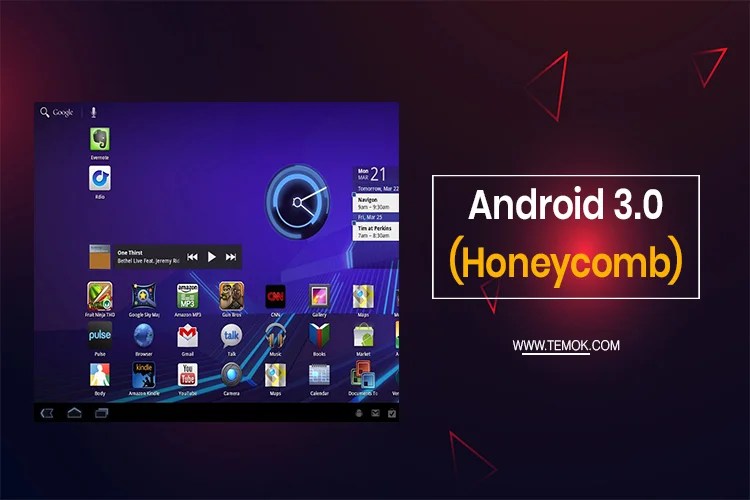
Android 3.0: Honeycomb (API 11)
Honeycomb from the Android version list was released in 2011, which was a tablet-only release to launch the Motorola Xoom. It was also suitable for those mobiles having a larger view than current smartphones.
Features:
- Gmail, contacts, camera, and gallery improvements
- Support for passwords with complex characters
- Encrypted storage and updated 3D UI
- Supports multiprocessors and recent apps for easy visual multitasking
- Media Sync from SD Card
- Action bar for application control
- System bar for global status and notifications
- Google eBooks and Talk Video Chat
- Support Adobe Flash in Browser
- More sensor support
- High-performance Wi-Fi Connections and Lock
- Chinese handwriting and redesigned keyboard
Android 4.0: Ice Cream Sandwich (API 14)
The ice cream sandwich was released on October 19, 2011, with many enhanced features to enter the era of modern design. The snapshot was introduced to take screenshots by holding the volume and power buttons. Android version list has a variety of Android operating systems but compared to all older versions, Ice Cream Sandwich widgets are more robust and resizable.

Features:
- Spelling check feature
- Wi-Fi Direct
- Photo Decor facility and on-screen buttons
- Unlocking with face recognition
- Card-like appearance for app-switching
- Improved video recording with high resolution
- Better Camera performance
- Ability to open up to 16 tabs in the web browser
Android 4.1: Jelly Bean (API 16)
The better version of Android known as Jelly Bean was released in June 2012 with Google Digital Assistant technology accessible from the home screen. The spectacular predictive intelligence utility provides expandable and interactive notifications. Moreover, users can enjoy multi-user support in play and many other valuable features.

Features:
- Voice search and typing
- Panorama
- Project Butter
- Expandable notifications
- Daydream as a screensaver
- Power control
- Support USB audio
- Improved camera app
- Security improvements
- New gestures and accessibility features
- Multiple user accounts (Only for tablets)
- 4K resolution support
- Supporting Bluetooth with low energy
- Bi-directional text and different language support
- Set or adjust the volume of incoming calls and show a message alert
- Google displays relevant content based on your search history
- Native emoji support
Android 4.4: KitKat (API 19)
Android version 4.4 was released on September 3, 2013, with more focus on better user experience. KitKat is optimized to run on a larger range of older versions from the Android version list. The smartphone must have a minimum of 512 MB of RAM.

Features:
- Screen Recording
- Contact Prioritization
- GPS Support
- Smarter Caller ID
- Offline music support
- UI updates for alarm and Google Maps navigation
- Cartoonish ideograms and emojis in the Google keyboard
- KitKat has an ‘OK Google’ feature that allows access to Google for users without touching their smartphones.
Android 5.0: Lollipop (API 21)
Lollipop or Android version 5.0, was released on November 12, 2014, with a redesigned user interface and built with “Material Design”. It gives a new and modern look extended across all Android applications and Google products. Lollipop from the Android version list comes with many amazing features, including Support for better notification management.

Features:
- Support ART
- Better device protection
- Notifications can be flicked away from the lock screen
- Better and improved UI
- Built-in battery saver feature
- New material design
- Revamped navigation bar
- Support for multiple SIM cards
- High-definition voice calls
Android 6.0: Marshmallow (API 23)
In the year 2015, Google used “Macadamia Nut Cookie” to describe Android version 6.0 before the Marshmallow official announcement.

Features:
- Support for Fingerprint readers
- Type-C USB support
- Multi-window experience
- ’Sleep Mode’ for saving battery life
- Clear permission system
- Custom Google tabs and improved Copy-pasting
Android 7.0: Nougat (API 24)
Android 7.0 was released in 2016 with a native split-screen mode, data saver functionality, and a “bundled-by-app” system to organize notifications.

Features:
- Provide multitasking and split-screen mode
- Storage manager enhancements
- Quick setting toggles
- Display touch enhancements
- Better setting application
- Inline reply to messages and notifications without opening applications
Android 8.0: Oreo (API 26)
Oreo was released in the year 2017 having native picture-in-picture mode, notification snoozing options, and better control over how applications can alert you with notifications.

Features:
- Password autofill
- Auto-enable Wi-Fi
- Downloadable fonts
- Multi-display support
- Support Picture-in-Picture
- Notification channels and snooze notification
- Google Play support and new emoji styling
- Adaptive icons and smart text selection
Android 9: Pie (API 28)
Pie was publicly released on August 6, 2018, with plenty of amazing features according to users’ interests and requirements. According to a report, Pie is the most widely used operating system in the Android version list.

Features:
- Sound amplifier with select-to-speak options
- Artificial intelligence (AI) compatibility
- Adaptive Battery and Brightness with background restrictions
- Multi-camera support with external camera compatibility
- New Gesture Navigation and App Actions
- New Screenshot Shortcut key and accessibility menu
- Easier Screen Rotation and edge-to-edge screen support
- Volume and Sound enhancements
- Selectable Dark Mode
- HDR, HD audio, multiple Bluetooth connections
- Slices and long-press to overview selection
- Improved Security features for extra protection
- Digital well-being with app timers, dashboard, and do-not-disturb options
- Android backups and privacy enhancements
- More Notification Information and easier text selection
Android 10: Android Q (API 29)
Android version 10 was officially released on September 3, 2019, with enhanced features and functionalities with higher API levels.

Features:
- Support for foldable smartphones with flexible displays
- Dark mode for eye comfort
- Navigation control over gestures is quicker and more intuitive than ever
- Sound amplifier with clearer sound
- Smart reply suggestions for all messaging apps
- Live caption for media playing on a smartphone
- Undo app removal
- Better notification control with many options
Android 11: Red Velvet Cake (API 30)
Android developers are continually working to provide more advanced applications as per the user requirements. Most of the developers are searching for Android Developer vs Web Developer to choose a trending field.

Features:
The following are the new features that you will experience in Android 11, which is going to be released and will be the latest version in the Android version list.
- Native screen recording
- Muting notifications during video
- Increase touch sensitivity
- Notification History
- Auto-revoke app permissions
The following are the revamped or updated features:
- Revamped menu and screenshot shortcuts
- New text selection mode from one app to another
- Undoing recently cleared applications
- Airplane mode doesn’t kill Bluetooth anymore
- Face Unlock will require you to open your eyes on Pixel 4
- App pinning in the share menu
- Improved notification conversation shades
- Conversation bubbles and context-aware dark mode
- Improved one-time permissions
Android 12: Snow Cone (API 31)
Android 12 (API 31) provides even more personalized, secure, and seamless experiences on your smartphone. Featuring a completely rebuilt UI specifically for you, fresh privacy features meant to keep you safe and in control, and additional intuitive methods to go directly to your gaming or even move to a different device.
Even the widgets have been thoroughly updated, so your favorite people are always there on your mobile phone home screen. Android 12 is also supposed to be more user-friendly, with a more roomy layout, color contrast enhancements, and new capabilities to assist individuals with low vision.

Features:
Android 12 has the following new features you must know because they will blow your mind:
- Scrolling Screenshots
- AppSearch
- Improved Auto-Rotate
- Easier WiFi Sharing
- One-Handed Mode
- Rich Content Insertion
- Overview Suggestions
- Game Mode APIs
The following are the updated features as compared to Android 11:
- Better Dashboard
- New Updated Design (Material You)
- Camera and Microphone Indicators
- Revamped Notifications
- App Hibernation
- Smooth Motion
Android 13: Tiramisu (API 33)
The most recent version for Android is Android 13. It is the most reliable and powerful operating system available today. It combines ambition and subtlety. Android 13 included a new user interface design for newer mobile devices.
The version also serves as the base for multifunctional items. It is preparing for larger displays and decisions, which will eventually debut on the forthcoming Google Pixel tablet. This OS generation has achieved significant improvements in terms of security, privacy, and speed.

Features:
Android 13 has the following new features you must know because it will blow your mind:
- Improved Security Features
- New Reading Mode
- Digital Car Keys
- Native LE Bluetooth Support
- Additional Material You Theme Options
- QR Code Scanner Support
The following are the updated features as compared to Android 12:
- Improved Privacy Features
- New Gaming Features
- Better Battery Life
- New Camera Features
- Updated Accessibility Features
- Updated Communication Tools
Android 14: Upside Down Cake (API 34)
Google crammed numerous important enhancements into Android 14, enhancing the customizability, proximity, and privacy of compatible devices, as well as making minor interface tweaks that smoothed out several long-standing rough spots.
In the most recent “The Android Show” podcast, Google’s Vice President of Engineering for Android, Dave Burke, stated that the Android 14 system has altered both the memory and the processor burden-balancing mechanism. He claims that this not only increases gadget performance but also battery life.

Features:
Android 14 has the following new features you must know because they will blow your mind:
- Smarter Scaling and Large Fonts
- Notification Flashes
- Restrictions for Photo and Video Access
- Protected PIN
- Data Protection
- Regional Preferences
- Predictive Back Gestures
- Health Connect
The following are the updated features as compared to Android 13:
- More Customization
- Improved Battery Life
- Improved Hearing Aid Supports
- Better Support for Larger Screens
- Improved Security
- Improved Share Options
Android 15: Vanilla Ice Cream (API 35)

The latest Android version 15, named “Vanilla Ice Cream,” was launched in September 2024. It is packed with new and amazing features. In terms of Android 15, the update brings several notable new features, including a system-level Private Space option that allows you to keep critical apps hidden and only accessible with authentication.
The software also improves the multitasking mechanisms introduced in Android 13 by adding the option of maintaining the large-screen-exclusive Android taskbar visible at all times and the ability to launch specific pairings of apps into a simultaneous split-screen with a single tap.
Features:
Below are the new Android 15 having the amazing following features:
- A private space from which you can hide sensitive apps.
- Boosted performance profiling to analyze the overall application performance.
- Improved Multitasking
- Updated focused service behavior
- Loudness controller that will reduce noise from the video.
Here are the upgraded features as compared to Android 14:
- More camera features, i.e., bokeh and low-light (night) mode
- Edge-to-edge UI Support for Apps
- Updated the SQLite version to 3.44.3 (Previously 3.40.1 in Android 14)
- Refined background performance
Android 16: Baklava (API 36)

Finally, the wait is over! Here is the latest Android version in our list, which is Android 16 Baklava. It was launched on 10th June 2025 and comes with a lot of updates compared to Android 15. With improvements including faster alerts, the Advanced Professional Video (APV) format, and better camera support for professional users, it improves productivity, security, and creative expression.
Stronger security measures like Advanced Protection are included, alerts are streamlined, and the Android Runtime (ART) has been improved for speed. For better accessibility and productivity, the update now adds desktop windowing and personalized keyboard shortcuts.
Features:
- Live Updates
- Force group notifications
- Notification cooldown
- Power button shortcut for wallet
- HDR screenshots
- Night Mode Camera extension API
- WritingTools API to let apps block AI writing tools
- New emojis from Unicode 16.0
- Health records
- Anti-scammer safeguards during phone calls
- Integrated photo picker
Compared to Android 15, the enhanced features are as follows:
- Better camera support
- Codec for Advanced Professional Video (APV).
- Simplified Notifications
- Increased Productivity
- Advanced Protection Mode
- Android Runtime (ART) Improvements
- Accessibility Enhancements
- Clearer Calling
Android 17: Cinnamon Bun (API 37)

Here comes the latest Android version: Android 17, aka Cinnamon Bun. Google published the official stable build of Android 17 for Pixel phones on June 16, 2026. Four beta releases preceded the stable release. For the first time in a while, Google stopped Developer Preview releases in Android 17. The brand skipped Developer Previews and went straight to Beta. To make things clearer, here’s the release timeline:
- Android 17 Beta 1: February 13, 2026
- Android 17 Beta 2: February 26, 2026
- Android 17 Beta 3: March 26, 2026
- Android 17 Beta 4: April 16, 2026
- Android 17 Stable Release: June 16, 2026
This version is focused on AI-assisted experiences, flexible app layouts, enhanced multitasking, greater privacy and security, and improved speed.
Features:
- Lock-screen Widgets
- Multitasking Bubbles
- Forced-Themed Icons
- Improved Blur Effects
- Separate Wi-Fi and Mobile Data Toggles
- Screen Recording Upgrades
- Hide App Names
- Ability to Remove at a Glance (For Pixel Phones)
- Better Factory Reset and Theft Protection
- Improved support for tablets and foldable devices
- Privacy-focused permissions
- RAW14 image support
Compared to Android 16, the improved Android 17 features are as follows:
- Smarter AI integration
- Better camera support
- Improved multitasking
- Better Large-Screen Support
- Stronger Privacy Controls
- Improved Security
- Android Runtime Improvements
- Enhanced Anti-Theft & Recovery
Android 18 (Coming Soon)
Android 18 is coming soon! Yes, we are here to announce this operating system’s features and release date! The majority of Android smartphone users will undoubtedly be thrilled to see a new OS version finally!
Android 18 developer previews are expected to begin in February 2027, with the stable release coming in mid-June 2027. However, Google has not set an official date. Moreover, Google broadcast Android 18 features focusing on stunning visuals, Jetpack Compose, and powerful AI integration prior to upcoming developer events, but has yet to release an official dessert name or public codename.
So, we have to wait for official confirmation from Google. Till then, stay tuned and keep visiting this blog for up-to-date information about the Android version list.
K.Yahoshuva
good presentation on Android versions , hope update the site regularly with new updates and information