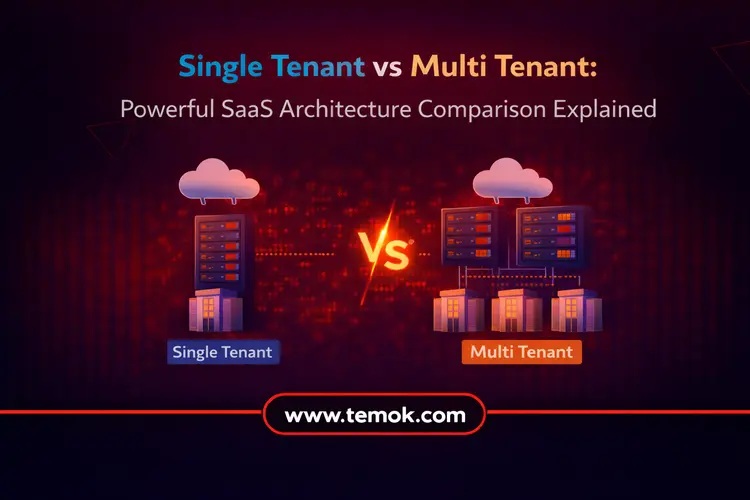

The majority of SaaS applications use multi-tenant architectures. Is it, however, the best option for your SaaS? All of your clients share a single instance of your application in a multi-tenant design, but their data is kept apart. Each of your clients receives a dedicated instance of your application when using a single-tenant architecture. You must first comprehend how Single Tenant vs Multi Tenant operate before making a decision.
Keep reading and exploring to learn what is single tenant and multi tenant in SaaS. Moreover, we will also discuss single vs multi tenant comparison to select the powerful SaaS architecture in 2026.
Table of Contents
Key Takeaways
- Whether SaaS clients employ dedicated or shared application instances is determined by Single Tenant vs Multi Tenant.
- For a premium price, a single-tenant design provides better security, isolation, and flexibility.
- For SaaS companies, multi-tenant design is more affordable, scalable, and simpler to operate.
- In single-tenant settings, managing security and compliance is simpler.
- Budgetary constraints, regulatory restrictions, and scalability considerations determine the ideal SaaS design.
What is Single Tenant and Multi Tenant?
Before we get into the single vs multi tenant comparison, let’s discuss what these SaaS tenants are in 2026.
What is a Single Tenant?
In a single-tenant architecture, each client (tenant) has its own entirely own instance of your program and its supporting infrastructure.
A single instance of an application or software system serves one client or customer at a time under a single-tenancy software architecture or hosting model.
To put it another way, every client or company has a separate, isolated instance of the program that runs on its own. Furthermore, each SaaS server can only have one instance due to the design.
The user interface of any program might especially suit the new renter or change after installation. Once the program is installed locally, tenants can frequently modify it to fit their needs better, but they do not have access to the underlying source.
Let’s discuss about multi-tenant architecture before jumping into single tenant vs multi tenant comparison.
What is Multi-Tenant Architecture?
In a multi-tenancy architecture, a single instance of your program serves numerous consumers. In a multi-tenant configuration, these resources are shared by all tenants, in contrast to single-tenant systems, where each client receives a specialized set of resources (such as storage, database query, and network).
But each tenant’s data is conceptually segregated from the others. Tenants can only view their own data since access is limited and restricted, even if all data may be stored in the same database.
In multi-tenant architecture, security is a critical issue that has to be properly addressed. You run the danger of a tenant accessing the data of another tenant if your access restrictions are inadequate.
Single Tenant vs Multi Tenant Pros and Cons

Just before we get into our main single tenant vs multi tenant SaaS architecture, let’s discuss the main pros and drawbacks of both of them.
Single Tenant’s Advantages
Here are some of the advantages of single tenant SaaS architecture:
Local Administration
The client has complete control over the product’s built-in settings or choices in a single-tenancy software paradigm. This suggests that the program gives users more freedom to personalize their experience and a lot more control over updates and upgrades.
Reliability
Because the tenant’s software operates independently, a single-tenant system has become extremely dependable. The performance of another tenant’s activity has no affect by running the software locally.
Security
Additionally, a more secure environment becomes possible by single-tenant software. Because each tenant’s information keeps itself entirely apart from that of other tenants, there is exceptional security.
Also Read: Cloud Computing Service Models: SaaS, PaaS, IaaS, and FaaS Explained
Backup and restore
Local software is installed and updated under the single-tenant model, and the tenant manages updates. This technique enables each user’s backup to complete independently and improves overall control when establishing backups and recovery options.
Migration
Tenants can move an application to their own managed servers if they choose to switch from a single-tenant environment to a self-hosted or local environment. If a move is necessary, this option enables a simpler procedure.
Adaptability
The framework and implementation have proper management in a single-tenant setting. Because of this control, the platform is able to provide greater customization options and control over the actions and features of the local program.
Single Tenant’s Disadvantages
Here are some disadvantages of single tenant architecture before we discuss single tenant vs multi tenant major differences:
Expensive
The cost of developing and maintaining single-tenant programs is usually higher. Your bills will soar due to the infrastructure expenditures alone (for things like databases and virtual machines). Naturally, you may raise your prices to meet the expenses.
Slower Development Time
Supporting every single tenant will significantly reduce the time it takes you to provide new features and address faults. This is due to the fact that you must ensure that all of the tenants you serve will be able to utilize your upgrades. You must work with each tenant’s administrator to ensure that crucial security patches are implemented as quickly as feasible.
Restricted Scalability
Scaling a single-tenant application is easy, but as your client base expands, it becomes more difficult since you frequently need to scale each customer’s environment separately.
Also Read: SaaS Business Model: Unlocking Infinite Business Possibilities
Multi Tenant’s Advantages
Multi-tenant environments have certain benefits that make them perfect for certain types of businesses. Here are some of them:
Cost Effective
Because the resources are shared, a multi-tenant system has a reduced cost per user. Spreading this expense enables better usage of the available finances.
Resource Advantages
The available resources comes sharing in a multi-tenant system to run at a greater utilization capacity. In addition to improving efficiency, this enables the system to move underused resources to areas with accessible resources.
Support Integration
When it comes to customer service, the majority of SaaS software development systems that use a multi-tenant design are more responsive. Therefore, you must choose wisely between single tenant vs multi tenant in 2026.
These businesses often offer considerably higher levels of service and support since they typically have more clients. Every client will have a better, worry-free experience thanks to our framework.
Service Tasks
Because the SaaS vendor handles backend upgrades and typically takes care of other maintenance concerns, a multi-tenant system requires less maintenance from the tenant. As a result, there is less emphasis on the tenants’ need to maintain up-to-date schedules and improvements.
Multi Tenant’s Disadvantages
Even while multi-tenancy cloud platforms house apps like Salesforce and ADP, there are still some restrictions that customers should be aware of.
Security Issues
There is a chance that another might access one customer’s data if you have shoddy database architecture and lax authentication procedures. A single database instance supporting several databases—one for each client and appropriately authenticating users—could be the solution to this problem.
Problems With Performance
The more users you add to your software, the less effective it will be if it is not built to scale. Reverse proxies, containers, and load balancers can all assist in controlling the load.
Single Tenant vs Multi Tenant Architecture: Key Differences

Now we will talk about single tenant vs multi tenant architecture comparison.
1. Use Cases And Industry Factors
For newer, smaller businesses that value speed and cost-effectiveness, multi-tenant architecture is frequently a better match. In contrast, single tenancy works effectively for bigger businesses, particularly in highly regulated sectors where data control, compliance, and customisation are crucial.
2. Data Isolation, Security, And Compliance
Data separation and security issues may arise when several customers’ data come in a single software instance due to multi-tenancy.
Single-tenant systems naturally segregate each client’s data, making it simpler to impose stringent controls, even if many of these dangers are mitigated by contemporary platforms.
To defend against credential-based attacks, both architectures must have strong Account Takeover (ATO) protection techniques.
3. Management Of Identities
Strong, fine-grained controls are necessary to keep user access and data visibility apart in multi-tenant systems since authentication and permission are centralized and scoped per tenant.
Single-tenant systems provide more flexibility for bespoke IdPs, SSO, and compliance frameworks, but they also increase administration costs because each client maintains their own identity instance.
4. Personalization And Feature Administration
Multi-tenant platforms are easier to operate but less flexible since they usually only provide a small number of vendor-specified configuration choices.
Although single-tenant settings are far more customizable, this flexibility frequently necessitates more technical supervision.
5. Implications For Costs
Due to sharing infrastructure and vendor-managed upgrades, multi-tenancy is typically less expensive both up front and during its lifespan.
Shared-cost approach creates economies of scale and reduces operating expenses for customers since suppliers coordinate maintenance, fixes, and updates centrally. Consequently, before deciding between single tenant vs multi tenant, one has to take cost considerations into mind.
Multi Tenant Vs Single Tenant: Which Choice Is Best For Your SaaS Application?
The multi-tenant architecture is nearly always the superior option for SaaS apps since it allows you to deploy a single instance of your application and serve a large number of users, ranging from 1 to 10,000. Because you need to submit changes to a single instance, adding new features to your app is also simpler.
However, there are some situations in which you should use a single-tenant design, such as when you wish to offer self-hosting and when security and data protection requirements require it.
FAQs (Frequently Asked Questions)
What Are The Disadvantages Of Multi-Tenancy?
Higher security threats, performance problems, restricted customisation because of shared infrastructure, development and administration complexity, and possible compliance issues for regulated industries are the primary drawbacks of multi-tenancy.
What is Meant By Single Tenant?
“Single tenant” refers to a dedicated environment that provides more protection, control, and customization by granting one person or organization (the tenant) exclusive usage of a software instance, its supporting infrastructure, and database.
What is An Example Of A Single Tenant Architecture?
A major company uses a dedicated, isolated instance of software such as GitHub Enterprise or Atlassian Jira as an example of a single-tenant architecture.
What is Considered A Multi-Tenant?
A multi-tenant system is actually an architecture in which a single software instance supports several clients (tenants).
Conclusion
You may gain a lot for your company by using either of these two Single Tenant vs Multi Tenant software. You can achieve more granular control by using a single-tenant software architecture, which can have implications for your internal support systems.
An outside company can deploy and manage multi tenant cloud applications. This type of technology allows you to focus less on the program itself and more on your company’s needs. As long as they work well with your company procedures, either of these options may be advantageous depending on your requirements.