
Quick Answer:
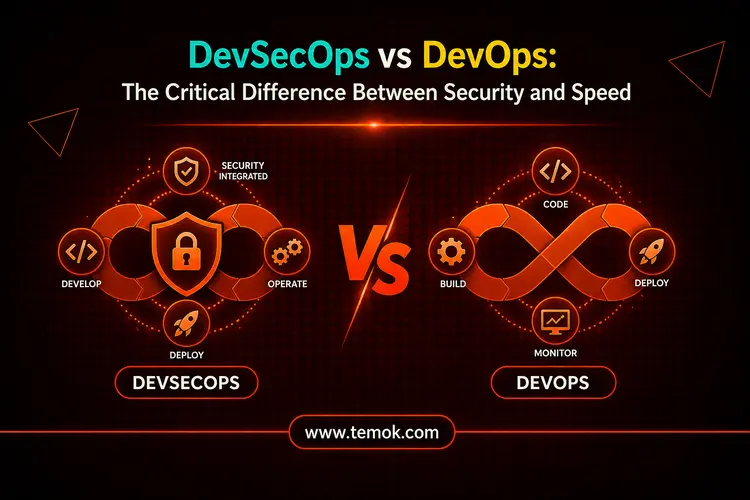
In DevSecOps vs DevOps, DevSecOps embeds continuous security into every stage, making systems more secure with slightly slower but safer releases. Whereas DevOps focuses on speed, automation, and faster software delivery.
Key Takeaways
- DevOps mainly focuses on speed and communication between development and operations teams.
- DevSecOps goes beyond this by integrating security across the whole development lifecycle.
- DevOps allows for 30-50% quicker release deployments, whereas DevSecOps reduces vulnerability detection rates by 40-60%.
- DevSecOps “shift-left” security can reduce breach costs by up to 30%, boosting long-term ROI despite somewhat longer release cycles.
- Organizations that use DevOps claim 60% fewer deployment problems, whereas DevSecOps provides continuous security validation across pipelines.
Introduction
The technical debt for security teams will increase by 75% for security decision-makers. According to Forrester, this will happen around 2026 as AI solutions advance fast. To be competitive, DevOps teams must keep several steps ahead of technological advancements. Understanding DevSecOps vs DevOps revolves around where and how security integrates into development operations.
DevOps streamlines interaction and automation to improve speed and stability, whereas DevSecOps adds continuous, built-in security with the purpose of limiting the effect on development speed and quality.
Keep reading and exploring to learn what is the difference between DevOps and DevSecOps and the similarities.
What is DevOps?
DevOps is a collaborative organizational approach that combines software development and operational groups. DevOps enables IT departments to exceed expectations and increase productivity.
Software development has seen significant changes throughout the years. Initially, the focus was solely on development and operations, with security being overlooked throughout the development cycle.
Every organization was under pressure to develop and deploy apps fast. Security was an afterthought, introduced later. The DevOps methodology focuses on innovation. It is about maximizing resource utilization, producing faster, and reducing waste.
How Does DevOps Work?
DevOps relies on one golden rule: automate what is feasible while simplifying the rest. Consider a well-oiled machine, where:
- Code flows smoothly from development to production, like a river.
- Feedback loops are tighter than your tightest deployment timeline and more efficient.
- Teams work together instead of blaming each other.
- Infrastructure turns into code, which then transforms into strong infrastructure.
The Primary Focus of DevOps
- Speed and efficiency: shortening time-to-market.
- Cooperation: Matching activities with development objectives.
- Automation: Using CI/CD pipelines to quickly create, test, and deliver code.
Let’s now discuss DevSecOps before getting into the DevSecOps vs DevOps key differences.
What is DevSecOps?
DevSecOps is the technique of integrating security throughout the software development life cycle (SDLC). It evolved from the DevOps movement and was built on the same foundation.
This concept is especially useful while working in the cloud, where strict security requirements and procedures must be followed.
More recently, the Dev Sec Ops meaning strategy is “shifting left” by including security in organizing, coding, building, testing, and deployment in order to be proactive throughout the development process rather than waiting until an application is published.
How Does DevSecOps Work?
DevSecOps takes the “shift left” method very seriously. Instead of considering security as the ultimate boss battle, it becomes a continuous companion throughout the development process. So, what is DevOps security? It is basically DevSecOps:
- Security screening happens automatically with every commit.
- Vulnerabilities are detected before they reach production.
- Security teams become enablers and not roadblocks.
- Compliance is built-in and not tacked on.
Here’s a breakdown:
Shift Left Security:
- Security checks begin before you write the first line of code.
- Threat modeling is as natural as creating user stories.
- Your IDE identifies security concerns before they reach version control systems.
Automated Security Gates:
- Dependency scanners know more about vulnerabilities than your complete security staff.
- SAST/DAST tools work in tandem with your tests.
- Container scanning detects errors before they reach production.
Security as code:
- Security rules are version-controlled, much like your application code.
- Automated compliance checks make auditors happy.
- Security tests run quicker than your coffee break.
The Primary Focus of DevSecOps
- Proactive Security: Detecting and correcting problems in real time.
- Shared Responsibility: Make security everyone’s responsibility, not just the security team’s.
- Continuous Risk Mitigation: Integrating security controls from code to the cloud.
Also Read: DevOps Engineer Jobs: Crack the Code Revolutionize Your Career
DevSecOps vs DevOps: Key Similarities

Before we get into DevSecOps vs DevOps key differences, let’s first discuss the similarities between the two.
Collaboration Culture
Both DevOps vs DevSecOps foster cross-team cooperation. DevSecOps brings together developers, operations, and security to break down barriers and improve overall efficiency.
Automation
Automation is a fundamental feature in both systems. Building, testing, and deployment are all automated to decrease mistakes and accelerate delivery, while Dev Sec Ops also automates security checks.
CI/CD Pipelines
Both use CI/CD pipelines to provide continuous integration and delivery. This enables speedier releases, faster feedback, and earlier issue discovery.
Efficiency And Improvement
DevOps and DevSecOps aim to optimize workflows and eliminate bottlenecks. Continuous improvement enables teams to provide better software in less time.
Shared Goal
Both strive to provide speedy, dependable, and high-quality software. DevSecOps essentially improves this by including security in the same workflow.
Here is a quick DevSecOps vs DevOps similarity table for your better understanding:
| Aspect | DevOps | DevSecOps |
|---|---|---|
| Automation | Build, Test, and Deploy Automatically | Automates Security and Development Testing |
| CI/CD | Fast Integration & Delivery | CI/CD With Built-in Security Checks |
| Efficiency | Streamlined Workflows | Efficient + Secure Workflows |
| Collaboration | Dev + Ops Teamwork | Dev + Ops + Security Collaboration |
Also Read: 100+ DevOps Interview Questions You Must Prepare To Get Job
What is The Difference Between DevOps And DevSecOps?
Here are the key DevSecOps vs DevOps differences you must know before choosing the right one:
1. Security
In typical DevOps pipelines, security is frequently confirmed later in the cycle – through specialized audits, penetration testing before release, or distinct review procedures. This can cause bottlenecks and raise the likelihood of detecting vulnerabilities too late.
DevSecOps, on the other hand, pushes this to the left by including security into the pre-coding and coding processes, ensuring that vulnerabilities are identified and corrected as soon as they are discovered rather than after the program is published.
2. Release Speed
When it comes to releasing the new software to the market, DevOps is often quicker than DevSecOps. It accelerates cooperation and promotes shorter, more frequent updates. DevSecOps integrates security into the design, planning, programming, testing, and deployment processes.
It automatically fixes vulnerabilities while testing, which might slow down production timeframes. However, the good news is that we will not have to tackle these difficulties later. DevSecOps updates take longer than DevOps updates, indicating a significant disparity between the two.
3. Team Capabilities
DevOps teams, which prioritize speed, efficiency, and process optimization, usually have expertise in development, operations, and automation.
Security expertise is added to the skill set in DevSecOps, requiring familiarity with threat modeling, security procedures, and compliance regulations. Throughout the software’s lifetime, this evolution guarantees that security considerations are firmly ingrained and included in every decision.
Cross-functional teams are beneficial to both DevOps and DevSecOps, but in order to handle security complexity, DevSecOps needs a wider range of capabilities. To successfully manage vulnerabilities, team members need to be updated on the newest security trends and technology.
4. Automation & Tools
Both DevSecOps vs DevOps approaches rely significantly on automation, although their scopes vary. DevOps automation focuses on development and deployment. Managed DevSecOps incorporates security gates into that automation. For example, if a high-severity vulnerability is found, the build may fail immediately, preventing vulnerable code from progressing to the next step.
5. Risk Mitigation
DevOps encourages deployment frequency. Without integrated security, this speed may unintentionally expand the attack surface. DevSecOps prioritizes ongoing risk mitigation. It guarantees that as your business grows and accelerates, so will your security posture.
DevSecOps vs DevOps: Quick Comparison
Here is a quick DevOps vs DevSecOps comparison table for your better understanding:
| Factor | DevOps | DevSecOps |
|---|---|---|
| Security | Added later in the lifecycle | Integrated from the start (Shift Left) |
| Release Speed | Faster Releases | Slightly slower due to security checks |
| Team Skills | Dev + Ops expertise | Dev + Ops + Security expertise |
| Automation & Tools | Focus on CI/CD automation | CI/CD + security scanning & validation |
| Risk Mitigation | Reactive Approach | Proactive and continuous risk management |
| Compliance | Limited built-in compliance focus | Strong focus on compliance and regulations |
| Testing Approach | Functional and performance testing | Includes security testing (SAST, DAST) |
| Cost Impact | Lower upfront cost, higher risk later | Higher upfront effort, lower long-term risk |
| Pipeline Integration | Security often separates | Security embedded in the CI/CD pipeline |
Important DevOps vs DevSecOps Use Cases in 2026
You’re bound to discover unique ways in which these approaches shape various sectors. The following is a detailed discussion of how DevSecOps vs DevOps both work in real-world circumstances.
1. Blockchain and Supply Chains
DevOps Use Case:
- Accelerates installations over distributed ledgers
- Enables real-time transaction validation.
DevSecOps Use Case:
- Adds security checks at each milestone.
- Prevents illegal alterations to contracts and traceable assets.
2. Fintech Payment Rails
DevOps Use Case:
- Supports continuous delivery for payment gateways.
- Enhances settlement system performance.
DevSecOps Use Case:
- Enables real-time fraud detection.
- protects against fraudulent transactions in regulated situations.
3. AI-Powered Healthcare Analytics

DevOps Use Case:
- Accelerates the deployment of analytics dashboards.
- Improves data processing procedures.
DevSecOps Use Case:
- Protects critical health information from exposure.
- Ensures compliance with requirements such as avoiding HIPAA violations.
4. Mobile Payments & Wallets
DevOps Use Case:
- Allows automatic builds and rapid upgrades.
- Provides continual QA feedback.
DevSecOps Use Case:
- Secures cryptographic elements and tokenization.
- Protects user funds against exploitation.
5. Personalized Banking Services
DevOps Use Case:
- Supports quick deployment of applications and dashboards.
- Improves customer-facing features.
DevSecOps Use Case:
- Integrates early threat modeling.
- scans microservices for vulnerabilities.
6. IoT for Advanced Manufacturing
DevOps Use Case:
- Improves real-time sensor data updates.
- Improves production monitoring systems.
DevSecOps Use Case:
- Prevents manipulation and industrial espionage.
- Detects and isolates untrustworthy devices early.
7. Augmented and Virtual Reality in Retail
DevOps Use Case:
- Enables rapid deployment of immersive retail experiences.
- Supports multichannel promotions.
DevSecOps Use Case:
- Protects user data and digital rights.
- Secures edge devices and AR/VR systems.
8. Smart Cities Projects
The last DevSecOps vs DevOps use cases are smart cities projects.
DevOps Use Case:
- Updates intelligent systems with gradual rollouts
- Enhances grid management and traffic systems
DevSecOps Use Case:
- Protects infrastructure and linked devices
- Safeguards vital systems, such as the water and electricity supplies.
DevOps or DevSecOps: Which is More Important?
DevOps and DevSecOps are supportive rather than competing techniques for delivering high-quality, secure software on time and within budget.
- DevOps introduced the techniques, automation, and collaboration required for fast, dependable delivery.
- DevSecOps has now enhanced those qualities by incorporating security into every phase of the process, guaranteeing that speed does not come at the expense of safety.
In fact, even organizations that have mastered DevOps require a clear strategy for expanding their DevSecOps program as the requirement for proactive, integrated security grows.
DevSecOps use cases are the obvious next step for today’s software development operations, improving trust and resilience while maintaining the agility that DevOps has enabled.
FAQs (Frequently Asked Questions)
Which is better, DevOps or DevSecOps?
When it comes to releasing the software to the market, DevOps is often quicker than DevSecOps.
What are the 7 C’s of DevOps?
- Continuous development
- Continuous integration
- Continuous testing
- Continuous delivery and deployment
- Continuous feedback
- Continuous monitoring
- Continuous operations
Will DevSecOps be replaced by AI?
We heard explicitly from DevSecOps experts that AI will not replace them; rather, it will profoundly alter their responsibilities.
Is Jira a DevSecOps tool?
Yes, Jira is a DevSecOps platform, primarily serving as a central orchestration center for integrating security technologies into development workflows.
Conclusion
If you can’t pick between managed DevSecOps vs DevOps, here’s a suggestion: prioritize DevSecOps first. The last thing you want to do is filter through data breaches and look for threat actors when they target your app’s vulnerabilities. DevSecOps may be slower than DevOps, but the work invested in it is worthwhile. Customers trust your applications and services more, which strengthens your company’s trustworthiness.