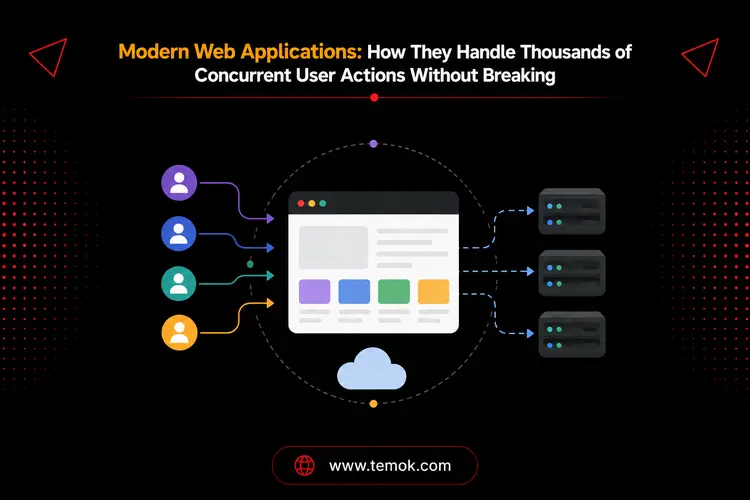

Modern web applications routinely serve thousands of users at the same time without any noticeable slowdown. A multiplayer gaming lobby, a flash sale on an e-commerce site, or a live-streamed event with audience interaction all manage enormous bursts of concurrent activity that would have crashed servers ten years ago.
Understanding how this works is more than just a curiosity for anyone who plays online games or develops web services. The differentiating factors between an application that is capable of handling heavy loads and one that collapses are due to particular technical decisions that have improved dramatically during the last fifteen years.
At its core, concurrent user handling is kind of like a resource management question, really. Every action a user takes, like clicking a button, sending a chat message, or moving a character in a multiplayer game, it uses up server resources.
Memory, processing time, network bandwidth, and database connections all have hard limits. When fifty thousand players in a battle royale all try to shoot in the same second, the server cannot queue requests sequentially. The architecture has to scale horizontally and handle each action with the smallest possible delay.
Load Balancing And Horizontal Scaling
Load balancing is the first defense against high concurrency. Instead of relying on a single powerful server, modern web applications distribute incoming traffic across many smaller servers running in parallel.
A load balancer lies in front of the server fleet, routing each request to the nearest computer with available resources. If one server slows down or dies, the load balancer professionally redirects traffic within milliseconds, so the user can never notice the lag while playing games.
Horizontal scaling means adding more servers to the fleet as load increases rather than upgrading any single machine, which gives the application effectively unlimited room to grow within the budget the operator is willing to pay.
For gamers who want to see well-engineered concurrent systems in action without committing to large downloads, browser games are a good choice. Modern browser games like Krunker.io, Slither.io, and Diep.io run entirely on web technologies and handle real-time multiplayer interactions using the same load-balancing and scaling techniques that power large-scale web applications.
Playing one of these games during peak hours provides a fascinating glimpse into how lag, latency, and packet loss react under real-world load levels, as well as what occurs when a server-side optimization fails. The casual gaming experience masks a complex infrastructure that is similar to what runs behind a number of banking websites and streaming companies.
Caching, Queueing, And The Database Problem
Beyond load balancing, the next major scalability technique is caching. A cache stores frequently requested data in memory so the server does not have to query the database for every single request.
When a player loads their profile page in an online game, the server checks the cache first. If the profile is there, the response is almost instantaneous. The database only gets touched when something genuinely needs to be written or refreshed.
Redis and Memcached are the two most common caching layers, and they sit between the application logic and the database to absorb the bulk of read traffic that would otherwise overwhelm the storage layer.
Queueing systems handle the right side of the equation. When ten thousand players simultaneously update their match results, the application does not write each result to the database in real time. Instead, the writes sort of go into a message queue (like RabbitMQ, Apache Kafka, or AWS SQS) and the database then processes them at a controlled pace, more or less, in a steady flow.
Additionally, the players can see a quick response due to the queue well-recognizing the write. However, the real database query operation may happen asynchronously in the background. This kind of decoupling is what enables high-performance writes possible without any need of database congestion.
Real-Time Architecture For Interactive Applications

The hardest concurrency problems in web applications come from real-time interactive experiences. A multiplayer game where every player needs to see other players move and act in the same fraction of a second requires more than traditional request-response patterns can deliver. WebSocket connections, which hold a persistent bidirectional channel between client and server, replace the older pattern of repeatedly polling the server for updates.
Also, in modern implementations of WebSocket, servers can handle something like tens of thousands of simultaneous links. Moreover, it is usually able to grow outwards in parallel, thanks to dedicated publish–subscribe mechanisms that send updates right away to every connected client in near real time.
The evolution from downloading Java games on Nokia phones in the early 2000s to today’s browser-based multiplayer experiences shows how much client-server architecture has changed. Old mobile games ran entirely on the device and synced occasionally with a server.
Today’s web browser games constantly transmit state changes, sometimes plenty of times per second. Moreover, the underlying design infrastructure readily handles the load using a powerful combination of WebSocket gateways, edge web servers, and protocol optimization. Moreover, the exact same patterns also power video conferencing, cooperative document editing, and live commerce platforms.
Why Graceful Degradation Matters More Than Raw Capacity?
The most important architectural principle behind reliable web applications is not raw capacity but graceful degradation.
It is true that no system has the capability to be scaled endlessly. So, software engineers design apps to fall short in a controlled ways under severe load instead of failing completely. However, when a multilayer gaming server reaches it full capacity, effectively organized systems will not allow for new connections instead of breaking existing sessions.
When the chat support becomes overloaded, the key message delivering system may get slow down by a couple of seconds instead of dropping the entire messages. Moreover, this kind of service requires very careful work on timeouts, circuit breakers, backup behaviors, and back-pressure signals that travel throughout the architecture.
The applications that gamers and users perceive as the most reliable are not necessarily the ones with the most server capacity, but the ones that handle their breaking points the most thoughtfully.
Also Read: Metaverse Games: Dive into The Infinite Reshapes Entertainment
What The Next Generation Of Concurrent Applications Will Look Like?
The architecture patterns described above are mature but not static. Serverless computing platforms like AWS Lambda and Cloudflare Workers are pushing the cost of horizontal scaling down to nearly zero by letting applications spawn execution environments on demand.
Edge computing reduces internet latency for real-time interactions by distributing application’s features among dedicated servers near clients. In any user-facing service that has to be responsive, persistent connections are gradually taking the place of request-response patterns.
The next generation of multiplayer games, live commerce platforms, and interactive social applications will combine these techniques in ways that make the current state of the art look heavyweight.
For anyone interested in concurrency engineering, the most interesting work over the coming decade will happen at the intersection of edge computing, persistent connection protocols, and stateful serverless platforms.