
The major RTO vs RPO difference is that RTO (Recovery Time Objective) refers to how long your systems can stay down until full recovery after a downtime, whereas RPO (Recovery Point Objective) means how much recently saved business data you can afford to lose after a disaster.
The Recovery Point Objective RPO and Recovery Time Objective RTO are two key variables in a disaster recovery or data protection strategy for an organization facing severe downtime. These are the objectives that might help businesses pick the best cloud backup and disaster recovery plan.
At first look, RTO and RPO both terms appear like they are quite similar. However, there are some differences organizations must understand before choosing the right objective.
So, keep reading and exploring to learn the key difference between RTO and RPO with examples. We will also walk you through the steps on how to set and reduce both objectives for your own systems.
Key Takeaways
- The RTO RPO meaning begins with one idea: RTO controls how fast you recover, and RPO controls how much data you can lose.
- RPO determines backup frequency, whereas RTO controls system architecture and recovery approach.
- Both RTO vs RPO are time-based, yet they address distinct problems.
- Lower objectives for either one generally result in higher costs.
- The proper objectives are based on the business impact of each task rather than a single company-wide value.
What is RTO (Recovery Time Objective)?
Recovery Time Objective RTO is the maximum acceptable time a business’s system, application, or process can remain unavailable after a disaster. In basic terms, it answers: “How fast can this downtime be operational again?”
Improving RTO enables speedier restoration of key services following an outage or cyber incident. This decreases downtime costs while also lowering SLA and brand reputation risk. It also enables teams to maintain business continuity for customer-facing and mission-critical activities.
Additionally, RTO does not just indicate how long it takes to transfer files from a backup. It may comprise detection, strategic thinking, infrastructure preparation, restoration, application launch, testing, and service recovery.
Moreover, for more detailed information and insights about RTO, we recommend reading our recent blog on What is RTO.
Let’s now discuss what is RPO before explaining RTO vs RPO differences.
What is RPO (Recovery Point Objective)?
Recovery Point Objective RPO defines the maximum volume of recent data a business can afford to lose after downtime or disruption. It also answers one question, but different from RTO: “How much recently saved data can a business afford to lose?”
Improving RPO decreases the amount of work, transaction data, and customer activity lost as a result of an outage or disaster. This is particularly relevant for systems that experience frequent changes, such as databases, SaaS data, and transactional applications. A lowered RPO protects income, promotes customer trust, and ensures better operational business continuity and disaster recovery.
For example, if a database has a recovery point objective of three hours, the recovery strategy should never have to fall back more than three hours to a readable copy. Moreover, documents frequently refer to this as the recovery point objective (RPO).
Moreover, for more detailed information and insights about RPO, we recommend reading our recent blog on What is RPO.
RTO vs RPO: What is the Difference?
The main RTO vs RPO difference is that RTO is all about how long data recovery can take, while RPO is all about how much data volume a business can afford to lose. Both utilize time as a unit, but one looks ahead to restoration while the other looks back to the last readable copy. Therefore, they both work together, yet they solve two different data recovery problems.
So, below is a quick recovery time objective vs. recovery point objective difference table you must look at to better understand the core difference between the two.
| Factor | RTO | RPO |
|---|---|---|
| Full Form | Recovery Time Objective | Recovery Point Objective |
| Definition | The maximum allowable downtime before system restoration | The maximum acceptable level of data loss following an incident |
| Main Focus | Downtime | Data Loss |
| Key Question | How quickly must we recover? | How much data can we afford to lose? |
| Measured In | Time | Time |
| Direction | Forward, after the disruption | Backward, from the disruption |
| Influences | Recovery infrastructure and procedures | Backup and replication strategy |
| Lower Target Requires | Faster Recovery | More frequent or continuous data protection |
| Example | If the RTO is one and a half hours, recovery must be performed within 90 minutes of the downtime | If the RPO is 20 minutes, data backups and replications must occur at least once every 20 minutes |
A good RTO vs RPO memory technique is to compare the T in RTO with the time required to restore service after a disaster and the P in RPO with the recovery point for data.
This is the fundamental RPO vs RTO difference. One protects the company against extended outages. The other restricts the quantity of recent work or data that may be lost during recovery.
Also Read: Acronis Cyber Protect Cloud: Why Temok Stands Out in Cyber Security Solutions
How Do RTO and RPO Work Together?
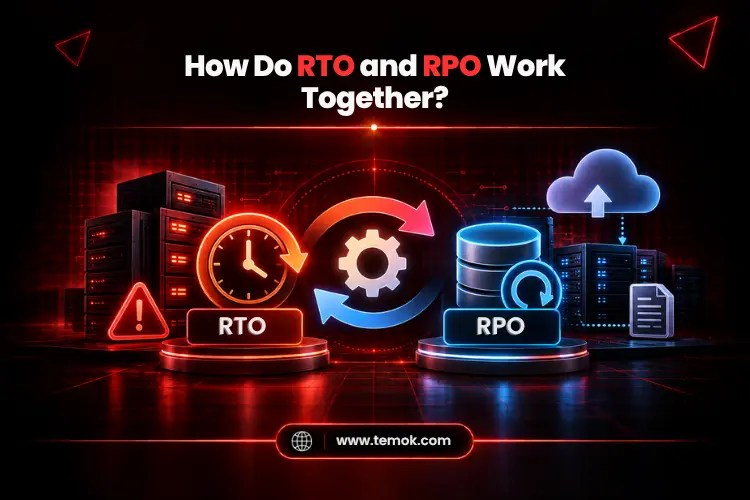
RTO and RPO address two different sides of the same business downtime or disaster recovery problem. RPO gives you the recovery point a business needs, whereas RTO determines how fast a business needs to return to normal operations.
Moreover, you can visualize RTO and RPO in disaster recovery with this simple timeline concept:
“Last Recoverable Point ← RPO → Disruption ← RTO → Service Restored”
Read it from left to right. Data is secure until the final recoverable point. Anything developed after that time but before the failure is at risk, and that gap is known as the RPO. The RTO is the time it takes for service to resume after a downtime.
RTO and RPO disaster recovery objectives demonstrate how much work you may lose and how long individuals would have to wait.
For example, imagine that an organization’s system breaks at 5:30 PM. If the RPO is 25 minutes, the recovery procedure should be able to access an appropriate recovery point by 5:05 PM or earlier.
On the other hand, if the RTO is half an hour, the service should be back up and running by 6:00 PM. That’s the real RTO vs RPO difference.
Can RTO and RPO Be the Same?
Yes, RTO and RPO can be the same because they can share the same numerical value being the same metric. However, they still measure different things.
For example:
- RTO: 25 minutes
- RPO: 25 minutes
The RTO of 25 minutes means the business service should be restored within 25 minutes. However, the RPO of 25 minutes indicates that an organization can only tolerate losing up to approximately 25 minutes of recent data.
RTO vs RPO Examples
The most effective way to fully understand RTO vs RPO examples is to consider how various workloads might have different recovery priorities. The statistics below are only illustrative, not general suggestions, because real targets depend on business impact.
| Workload | Example RTO | Example RPO | Reason |
|---|---|---|---|
| E-commerce Platform | 30 minutes | 5 minutes | Downtime and missed transactions are expensive |
| Business Email | 2 hours | 1 hour | Important, yet little disruption is tolerated |
| Internal File Archive | 8 hours | 24 hours | Lower operational urgency |
These RTO RPO examples all teach the same lesson. The more money a system generates, or the more consumers depend on it, the stricter the objectives become.
How To Determine RTO and RPO?
You can determine RTO and RPO by ranking different systems by business impact, data value, technical dependencies, and realistic recovery capabilities, then selecting targets you can afford and achieve in reality.
You must not choose RTO vs RPO just because you found a particular number impressive. Here are the steps that a business must work through for each workload:
1. Identify Critical Systems and Data
- List the apps, different types of databases, and services that are critical to corporate operations.
- Include both production and support systems (such as authentication services).
- Payment systems, client records, and core databases are typically the top priorities.
2. Assess The Impact of Downtime
- Determine what would happen if each workload went offline for an hour, a day, or a week.
- Consider revenue, client trust, productivity, and contract requirements.
This contributes to establishing a recovery time objective RTO rather than an unreasonable target.
3. Determine Acceptable Data Loss
- Ask yourself: How much data may we lose if this system fails without causing a severe impact?
- Consider the regulatory requirements, financial exposure, and consumer impact.
This establishes the recovery point objective RPO.
4. Evaluate Recovery Technologies
Examine the currently available technology and find any gaps.
This may include:
- Backups and Snapshots
- Incremental backups
- Data Replication
- Failover systems
- Redundant infrastructure
- Recovery automation
- Offsite recovery copies
Your goals should be feasible with the recovery architecture you use.
5. Calculate Data Change Rates
- Determine how often data is updated for each task.
- Highly transactional systems, such as e-commerce, may demand near-zero RPO.
6. Balance Recovery Requirements with Cost
- Stringent objectives typically call for more investment. Faster recovery may need redundant infrastructure, automation, backup systems, or more complex recovery procedures.
- Similarly, an extremely low RPO may need more frequent backups or replication, which might raise storage, network, and operational requirements.
- The objective is not to keep each RTO vs RPO as minimal as practicable. The objective is to make them suitable for the business.
Also Read: Security-First Development Playbook: How Fintech CTOs Secure Data Without Delays
How To Reduce RTO and RPO?
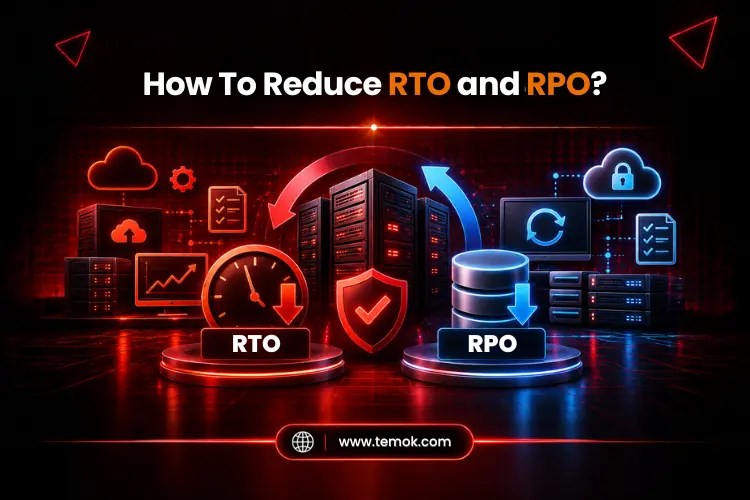
You reduce RTO by making the data recovery process faster, and RPO by making the data recovery points more frequent. Because RTO and RPO address separate recovery goals, strategies for reducing them must be different. So, strategize them separately when establishing your RTO/RPO backup strategy.
Ways to Reduce RTO
To reduce recovery time, organizations can:
- Automate recovery actions to keep individuals from entering commands during a crisis.
- Use failover systems to take over when the primary fails.
- Build high availability into important services.
- Implement faster storage and infrastructure for restoration.
- Test disaster recovery techniques on a timetable.
Testing is important because an untested recovery plan may not perform as intended in a real-world disaster.
Ways to Reduce RPO
To reduce RPO, organizations can:
- Run backups more regularly.
- Minimize frequent copies using incremental backups
- Replicate data to a separate infrastructure
- Consider continuous data protection for important workloads.
- Maintain secure recovery copies that attackers cannot modify.
For example, if an organization moves from daily data backups to hourly backups, it can provide more obvious recovery points. However, the actual achieved RPO relies on the entire protection process.
In that case, an immutable backup strategy can truly help in protecting data recovery copies from any unauthorized alteration or deletion. However, immutability itself never automatically creates a lower recovery point objective RPO.
Let’s now discuss why RTO vs RPO are very important for disaster recovery.
Why Are RTO and RPO Important for Disaster Recovery?
RTO and RPO are important for disaster recovery because they have the capability to turn a disaster recovery plan into measurable recovery objectives. Without them, organizations can have a backup, but it will lack a clear understanding of how quickly systems need to return or how much recent data can be lost.
RTO and RPO help organizational teams make practical decisions that help you:
- Set recovery priorities to ensure vital systems return first.
- Plan infrastructure that meets genuine business demands.
- Select the appropriate backup frequency for each task.
- Choose recovery technology you can justify.
- Ensure business continuity with a defined plan.
- Test recovery and see whether the figures hold up.
RTO vs RPO is also directly related to business continuity planning. A recovery strategy should be focused on the business effect of an outage, rather than seeing all applications as equally critical.
RTO vs RPO FAQs
What is RPO and RTO in AWS?
In AWS, RTO (Recovery Time Objective) and RPO (Recovery Point Objective) are the two major metrics that are readily used in the AWS disaster recovery strategy to clearly define its downtime and data loss limits. Backups, cloning, snapshots, standby infrastructure, and other services can be used in AWS recovery plans to achieve these goals.
How do you calculate RPO?
RPO is calculated as the maximum quantity of recent data that the company can afford to lose. For example, if missing more than 30 minutes of transactions will result in unacceptable repercussions, the recovery design must provide an RPO of 30 minutes or better.
Can RPO be longer than RTO?
Yes, because RPO and RTO are both independent objectives. For example, if daily backups are acceptable, a system may need to be back up and running within one hour (RTO) while allowing for up to 24 hours of lost data (RPO). The reverse combination is also frequent.
What is the difference between RTO, RPO, and MTD?
RTO sets the goal recovery time, whereas RPO specifies the tolerable level of recent data loss. On the other hand, MTD, or Maximum Tolerable Downtime, is the maximum amount of time a business process can be unavailable before the consequences become intolerable. These measures can be combined in setting priorities for recovery.
Conclusion
The simplest reason for RTO vs RPO is that RTO limits downtime, but RPO limits data loss.
The RPO vs RTO choice is not about choosing one. It is necessary to configure each number for each system based on real-world business impact, and then back up the numbers using appropriate backups, replication, and testing methods.
A solid disaster recovery strategy integrates both metrics and actual recovery operations. Define them for individual workloads, then select protection and recovery solutions that can realistically satisfy them. Test those methods on a regular basis.