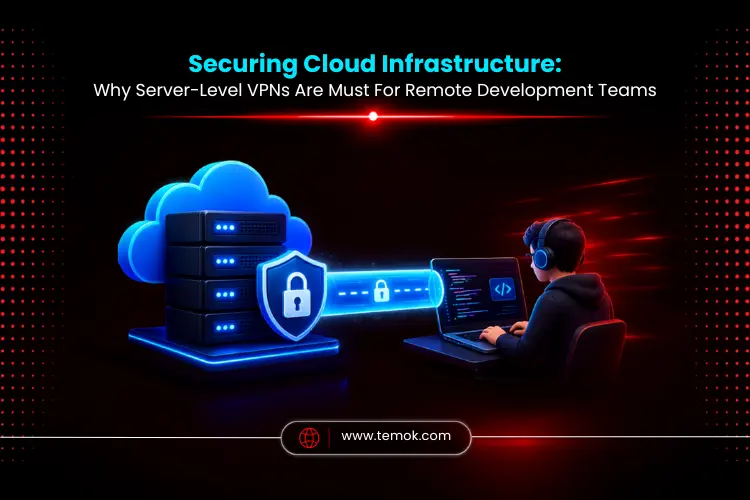

The engineering team’s shift to a distributed working culture has completely demolished the old perimeter-based security system. Software developers no longer sit behind a single office firewall, but instead work from home, office space rentals, and cafes across the world. Undoubtedly, remote working and flexibility of working time have increased productivity and satisfaction of employees; nevertheless, it has created an almost endless surface for security threats. Ensuring protection of the assets in the cyber world calls for a more stringent Cloud Infrastructure Security policy than a simple password change and a multi-factor authentication technique.
If a developer connects to a production database, continuous integration pipeline, etc., or uses an open network at home without having any sort of data encryption, an organization opens itself to a possible man-in-the-middle attack that can get you credentials, sniff out sensitive data, and allow lateral movement through unauthorized pathways. The solution that engineering departments usually opt for is deploying server-level or client VPNs that are specific to servers. This method establishes the security connection right at the server host level so that only the people who are authorized to do so can interface with the private cloud resources via that tunnel.
Why Cloud Infrastructure Security Matters
By migrating their business operations, applications, and data to the cloud, companies have also transferred their reliance, in certain aspects, from their own physical data to cloud service providers. Nonetheless, it’s still up to the developer teams to make sure that the cloud resources are properly protected. In a sense, hardware-level security at cloud providers’ level is great; they offer robust physical and hardware-level security measures – but software-level security and management of cloud infrastructure is the developer’s job.
In a real-world situation, a single poorly configured security group or an open database port can be very detrimental and result in losing data through hacking or leakage and other breaches such as intellectual property theft, and regulatory compliance violations.
As the development cycles are being managed as short-lived entities, maintaining Cloud Infrastructure Security comprehensively proves challenging. Developers regularly create instances temporarily, test microservices, and push their code updates. If these environments are not monitored and encrypted, they may create issues for security. It is like a situation where everything within the network is assumed to be safe (traditional perimeter security model – which isn’t the case anymore) while actually the “perimeter” has widened to wherever your developers are accessing your network. It is not a network per se; it is them! So if they are on the other side of the world, the network extends to that point as well.
Challenges of Remote Development Teams
If remote development teams need to remain productive but, at the same time, they want to be able to keep the workflows safe, it’s not very clear or straightforward. It is always good to start identifying security issues before taking countermeasures or at least get an idea of the problem to be resolved:
- Home Internet Is Insecure: Developers may frequently make use of home or public Wi-Fi networks with limited or no enterprise-level encryption where packet sniffers can intercept API keys, SSH credentials, and source code. This poses a serious risk not only to personal data but also to the organization’s confidential information. Therefore, remote developers need to be extra cautious, even though such networks seem more than okay for day-to-day activities.
- Cyclical Home IP: It seems a rather big task for the developers in case the home internet service providers are the ones constantly re-allocating dynamic IP addresses. The use of static IP whitelisting for database access either becomes a problem or the maintenance of that is too hectic to be done manually.
- Different Environments: In a typical scenario, the engineer is simultaneously working with development, staging, production, third-party APIs, etc. Such varied access paths are quite difficult to trace, audit, and manage, especially since the engineer may need different credentials and passwords for these environments.
- Slow and Ineffective Security Methods: The use of clunky and complicated security tools can lead to slowdowns in compilation times, interfere with SSH communication, and even cause frustrations for developers. As a result, they may end up turning to the so-called shadow IT solutions that completely bypass the security protocols.
The challenge lies in being secure, and at the same time, not getting bogged down by the security processes. Therefore, it is quite a common thing for a business unit to think and decide between Dedicated Server and VPS Hosting in terms of how one’s isolation level is impacted by the underlying hardware.
Also Read: Deep Web vs Dark Web: Powerful Breakdown of Hidden Internet Layers
What is a Server-Level VPN?
Unlike the usual home or consumer-type virtual private networks, which direct one’s entire web traffic through the commercial proxy, a server-level VPN is physically installed on a cloud server or a gateway machine. It creates a special encryption channel that only the developer at one end and the server/cluster at the other will have access to – in fact, it’ll be a two-party communication through the private network.
With a server-level VPN, the remote machine, from wherever the developer chooses to sit in the world, is a logical part of the corporate virtual network. According to VPNpro research, access by users from encrypted gateways centralized considerably reduces the surface on the network that is under attack by concealing administrative ports such as SSH (22), RDP (3389), and database ports away from the general public. It really comes down to the fact that someone can only get to a machine’s service port after the handshake has happened and they have been authenticated through the secure private communication network.
Top Advantages of Server-Level VPN

Incorporating a server-levelVPN is one of the engineering practices that lead directly to immediate improvements and long-standing benefits in terms of the tech and business of the company:
Restricted Access
If you protect your cloud resources by putting them through a VPN, you’ll never have to leave your ports in the public. Even if a zero-day vulnerability happens to appear in a service, you will not see an attack if no one can get the attack to that vulnerable port over the tunnel.
Whitelisting at IP Level Simplified
Your security team no longer needs to spend all their time updating and keeping up with thousands of remote developers logging in from different home IP addresses. All they need is to allow the server-level VPN gateway’s one static IP address at the firewall. That saves them time and, at the same level, increases their security.
Encrypted Code and Data
All kinds of pushes, queries, environment variable transfers, payloads, etc., get securely wrapped by encryption schemes such as WireGuard and OpenVPN, which render them completely safe against eavesdropping at the local level. When you’re planning to scale your deployments, knowing Cloud Hosting Benefits helps engineering leaders build scalable applications with automatic scaling of the vpn gateway together with application nodes.
What Difference is There Between Server-Level And Traditional VPN?
Some companies wrongly use off-the-shelf commercial VPN products primarily meant to protect privacy, mask web activities, and help overcome geolocation as their solution to engineering workloads. These are not even in the same ballpark:
| Feature | Traditional / Commercial VPN | Server-Level VPN |
|---|---|---|
| Primary Purpose | User privacy, masking browsing habits, bypassing geo-blocks | Securing infrastructure access, isolating cloud environments |
| Control & Ownership | Managed by third-party commercial providers | Fully self-hosted and managed by your DevOps team |
| IP Stability | Dynamic, shared IP addresses across thousands of users | Dedicated, static IP addresses mapped to your infrastructure |
| Performance | Often bottlenecked by crowded public server nodes | Optimized for low-latency developer SSH and database queries |
| Customization | Minimal configuration options | Granular firewall rules, routing tables, and key management |
Using a Private Cloud and VPN together
Combining vpn and private cloud together for maximum security can be a really good and smart move.
In a modern engineering department, it’s quite common to have a workflow set up that is a top-level one over a private cloud platform. Multi-tenant public cloud services are very cheap when compared to the private ones, but highly sensitive information that is not supposed to be seen by anyone except the right set of eyes, such as intellectual property, algorithms, or the company’s ‘how-to’ secrets, can really be very well protected only if they are housed on the customer’s own server in a dedicated cloud computing environment.
By coupling a secure private cloud server with a server-level VPN, you’ve basically created an impervious layer for your complete development cycle. Developers access the gateway server via public-key cryptography or hardware tokens to authenticate themselves and get into your secure VLAN housing an isolated environment of staging servers, continuous integration or deployment runners, and an internal documentation wiki – away from the eye of the general public. This means your internal documentation is just as safe, and your developers feel completely protected while working on your most secret projects and data, which only the team should have access to.
Security of Remote Development Through Best Practises
The hardware side of things may be all sorted out, but the remote engineering department is still expected to observe certain security measures which together form the best practices to stay as secure as possible:
- Force Key-only Login: Turn completely off login via password for both the VPN gateway and the cloud servers that it is connecting to, so any developer can only gain access by using the SSH keys or the 2FA physical tokens.
- Least Privilege Principle Implementation: Divide your network in a way that a front-enddeveloper will not have back-end database access, but a back-end developer will have front-end staging server access. This restriction prevents lateral movement if a workstation that is compromised is being used as the entry point.
- Purge or Rotate Keys Regularly: Establish a routine where team members exiting the project or changing their roles have all vpn-certificates, their ssh- keypairs are revoked and reissued automatically – no manual work is required.
- Connection Logs Monitoring & Auditing: Maintain central logs for all vpn connection sessions to detect and prevent unusual access attempts through the logging of such details as who connected, the hour, and the duration.
Teams maintaining Linux environments can combine Linux Server Security Best Practices such as installing fail2ban, configuring strict limits on logins to root, and applying proper file permissions to secure access at network-level, with vpn controls in the case of building up a true multiple-layer defense architecture.
Stumbling Blocks to Beware of
Even experienced DevOps specialists sometimes run into problems when setting up remote access. Be especially cautious not to
- Depend on security through obscurity: simply changing the default SSH port is definitely far away from a proper vpn. You can be assured that port scanners that are fully automated will discover those services within no time.
- Undervalue the Split-Tunneling Risks: Enabling a development team to route local internet traffic simultaneously as they do when accessing a corporate system could be an avenue from which a home network could get infected, and the virus be transmitted back again via a corporate tunnel.
- Fail to Measure VPN Gateways’ Performance: Not getting enough CPU or sufficient memory allocated to a vpn gateway can trigger packet losses, delays in SSH terminal responses, etc and in return get you angry developers with a big grudge.
- Stale Access Lists: Forgetting to revoke VPN access for contractors or former employees who have finished their tenure with the company.
The Last Word
Remote development has become a necessity, but you do not have to sacrifice engineering speed due to security issues that come with distributed teams. Relying on perimeter defense methods or insecure remote connections will expose your cloud resources to modern threat actor activities. Deploying a dedicated, server-levelVPN will bridge the gap between developer freedom and security without any compromise.
In addition, if you couple strong cryptographic tunnels with a secure isolation mechanism of the private cloud infrastructure, all the source code, databases, and deployment pipelines on your system could effectively be locked out from attacks on the open internet by your private security system. With such architectural steps, you can secure your company’s valuable intellectual property and empower your remote engineering team to confidently & safely build, test, and ship products.