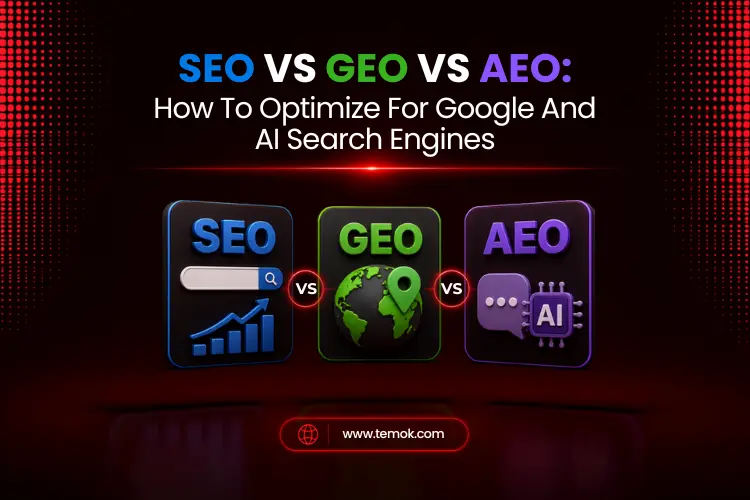

SEO vs GEO vs AEO is no longer about selecting one strategy and disregarding the others. SEO improves your content’s visibility on Google and Bing. AEO promotes your content as the straight response in featured snippets and AI Overviews. GEO enables AI technologies like ChatGPT and Google Gemini to mention your material. In 2026, all three are important and collaborative.
Key Takeaways
- Traditional Google rankings are still important, but they are no longer the primary aim.
- AI-generated responses increasingly influence how consumers seek information, assess possibilities, and make decisions online.
- Strong technical, on-page SEO, and off-page SEO remain the cornerstones of online presence.
- Optimizing for answer engines, featured snippets, and voice search increases zero-click visibility.
- Generative engine optimization helps AI systems comprehend, trust, and reference your information.
- The most successful websites use SEO, AEO, and GEO to increase visibility.
Introduction
You worked hard on your website. Your articles are comprehensively written. Your web pages load quickly. However, web traffic continues to decline, and your content is no longer prominently displayed.
Here is what nobody warned you about: the way people search has now fundamentally changed.
In 2026, AI search engines such as ChatGPT, Google Gemini, and Perplexity AI now answer inquiries directly. Users can receive entire replies without ever visiting a website. Google AI Overviews appear atop all results. Voice assistants give answers aloud.
This is precisely why the debate between SEO vs GEO vs AEO has emerged as the most significant in digital marketing. Mastering one of these techniques is no longer sufficient.
This comprehensive blog clearly explains all three, demonstrates how they vary, and tells you how to utilize them together.
So, keep reading and exploring to learn the key GEO vs AEO vs SEO differences and how you can optimize your valuable content for Google AI Overviews and AI search engines.
Why Search Optimization Is Changing?
Searches used to be straightforward. You entered a few terms, and Google returned 10 blue links. You picked the one that appeared most beneficial.
That model is mostly gone.
Google AI Overviews now display above all organic results for the majority of informative inquiries. Conversational search has replaced keyword-based typing, particularly on mobile devices, web browsers, and smart speakers. Zero-click searches now account for the bulk of all inquiries, allowing consumers to acquire answers without ever visiting a website.
At the same time, generative AI tools have become the key research platforms. Professionals utilize Microsoft Copilot to study providers. Students utilize the ChatGPT chatbot to grasp complicated concepts. Buyers utilize Perplexity AI to compare different products. Claude is increasingly being utilized for a variety of purposes, including writing assistance and business research.
All of these platforms pull from web content for AI citations. They select, synthesize, and cite. They do not rank sites in the same way Google does. They pick which sources are reliable and worth including in their responses.
This is why you must employ AI search optimization strategies that go beyond typical SEO. Your content now has to serve several search surfaces at once.
What is SEO (Search Engine Optimization)?
SEO is a key strategy of optimizing a website so that the best search engines such as Google can find, interpret, index, and rank its pages for relevant queries. Although artificial intelligence is transforming the way people search, SEO remains the cornerstone of online exposure.
To understand SEO vs GEO vs AEO, you first need to understand the role of traditional search engine optimization.
How SEO Works?
Search engines use bots to crawl your sites, scan your content, and add it to their index. Crawlability affects whether the bots can reach your site in the first place. Indexing affects whether your pages may appear in search results at all.
Once indexed, Google uses hundreds of signals to determine search ranks. Content quality, backlinks, user behavior, and site experience are all important considerations.
Core Components of SEO
- Technical SEO focuses on site performance, mobile usability, Core Web Vitals, and site architecture. It serves as the foundation for all subsequent SEO efforts.
- On-page SEO focuses on your content’s quality, header structure, meta tags, and keyword research. Each page should clearly address a single issue.
- Off-page SEO is achieved by backlinks, brand mentions, and signals from other sources indicating that your content is trusted by others.
Benefits of SEO
A great SEO strategy offers long-term benefits.
Some of the most significant benefits include:
- Sustainable organic traffic
- Improved exposure on Google
- Increased brand credibility
- Increased qualified leads
- Increased customer trust
- Long-term Return on Investment
Even as AI search advances, SEO remains the foundation for almost every effective digital marketing plan.
Limitations of Traditional SEO
AI SEO has revealed a significant gap in the old technique. SEO was created for a world in which people clicked links. As AI-generated responses replace clicks, ranking no longer ensures visibility.
You can be ranked number one on Google and yet miss out on the visitor who received their answer from an AI Overview without even scrolling. That is where SEO vs AEO becomes an important discussion.
Let’s discuss what is AEO meaning before discussing SEO vs GEO vs AEO in detail.
What is AEO (Answer Engine Optimization)?
If SEO helps users find your website, answer engine optimization helps users find your answers.
AEO focuses on providing information that immediately answers issues in a clear, organized, and understandable style.
Instead of focusing just on rankings, AEO prioritizes exposure across AI-generated summaries, voice search assistants, and direct response boxes.
Understanding SEO versus AEO helps organizations adapt to shifting search behavior.
How AEO Works?
Answer engine optimization focuses on what SEO specialists call “position zero.” Instead of pursuing the first blue link, AEO strives to be the content that Google reads aloud or shows as the top response.
They want stuff that provides:
- Direct answers
- Logical structure
- Accurate information
- Clear formatting
- High credibility
You accomplish this by creating short, factual, and well-structured information that directly answers particular queries.
Featured Snippets
The highlighted snippets section on Google is one of the earliest examples of AEO. Featured snippets offer short solutions just above typical search results.
Content with precise definitions, tables, bullet points, and clear headers has a greater chance of achieving these rankings.
Although AI search evolves, highlighted snippets remain useful because they boost exposure and authority.
Also Read: SEO VS SEM: What Are They And How Do They Differ?
Google AI Overviews
One of the most significant advances in search is Google AI Overviews. Instead of presenting merely website links, Google now displays AI-generated summaries based on data obtained from reliable sources.
Websites that give accurate, comprehensive, and well-structured content have a better chance of being cited in this summary. This makes AEO a critical component of any current SEO content strategy while comparing SEO vs GEO vs AEO.
Voice Search Optimization
Millions of individuals use voice assistants every day. To optimize for voice search, write organically and answer whole inquiries rather than targeting only short keywords.
For example, users often ask questions such as what the difference is between SEO and GEO, how they can improve website rankings, or which SEO strategy is best in 2026. These conversational queries should be properly addressed in your content.
Benefits of AEO
Direct visibility in zero-click search results.
- Increased brand recognition when your content is spoken aloud or shown.
- Improved alignment with how people will ask questions in 2026.
- Increased possibility of being featured in Google AI Overviews
Let’s now discuss GEO before getting into SEO vs GEO vs AEO key differences.
What Is GEO (Generative Engine Optimization)?
GEO, or Generative Engine Optimization, refers to increasing a site’s exposure in AI-generated replies rather than simply in a ranked list of search results.
Traditional SEO aims to rank a page for a query and earn a click. The purpose of GEO is to integrate your content, brand, or website in the pool of sources from which AI algorithms generate answers, summaries, or recommendations.
How GEO Works?
Generative AI techniques do not rank pages. They read the information, evaluate its reliability, and decide whether to include it in their answer. AI search optimization necessitates a completely different strategy than traditional SEO.
The objective is to become a trusted source within AI knowledge systems, rather than merely a high-ranking site on Google.
AI Search Engines
Several recent AI search engines already use this strategy. Examples include ChatGPT, Google Gemini, Claude, Perplexity AI, and Microsoft Copilot.
When producing answers, these platforms increasingly make use of reputable websites. Earning these crucial AI citations may greatly boost company visibility, even if visitors never go to Google directly. This is the best strategy while comparing SEO vs GEO vs AEO in detail.
Entity-Based Optimization
Entity optimization is ensuring that your content is organized around clearly defined subjects, such as specific persons, businesses, goods, places, and concepts. This is how AI models determine what your content is about, not by matching keywords, but by identifying things and their relationships.
Knowledge graphs are the frameworks that AI systems employ to represent these relationships. When your content properly flows into these graphs, you join the trustworthy information layer that AI systems rely on.
Topical Authority
Publishing a decent article is no longer sufficient. Modern AI appreciates webpages that exhibit extensive knowledge across a broad field.
Building topical authority entails writing several interrelated articles that cover every key feature of a topic. Strong internal linkage, thorough coverage, and semantic relevance all help to increase authority.
This strategy also helps traditional SEO while enhancing GEO performance.
Benefits of GEO
- Your brand appears within AI-generated responses seen by millions.
- Creates long-term authority that stretches well beyond Google.
- Future-proofs your content strategy as AI search expands.
- Generates trust signals that accumulate over time.
Some individuals confuse GEO with geographic SEO or geo in product searching. These are distinct ideas. Geographic SEO focuses on increasing exposure for location-based queries, such as local companies, whereas GEO in product search often refers to filtering items by place or region.
Generative engine optimization focuses on enhancing how AI systems discover, comprehend, and reference your information.
Ultimately, the discussion around SEO vs GEO vs AEO, SEO vs GEO, SEO vs AEO, AEO vs GEO, and GEO vs AEO is not about choosing one winner. Each approach addresses a unique difficulty, and when combined, they form a solid basis for search success in 2026 and beyond.
Also Read: How Long Does SEO Take: Understanding The Timeline For Results
SEO vs GEO vs AEO — Key Differences
After understanding each strategy separately, the next step is to compare SEO vs GEO vs AEO side by side. Many marketers ask if one method is replacing another, but the answer is much simpler.
Each approach serves a distinct role in the current search ecology. Traditional SEO helps users find your website through search results, but AEO allows search engines and AI systems to provide your content as direct solutions.
GEO assists large language models in understanding, trusting, and referencing your content when generating answers. Instead of competing, these three strategies collaborate to increase your online presence. Here is a comprehensive SEO vs GEO vs AEO comparison table you must look at for a better understanding:
| Feature | SEO | AEO | GEO |
|---|---|---|---|
| Primary Goal | Improve Search Rankings | Deliver Direct Answers | Earn AI References and AI Citations |
| Target Platforms | Google, Bing and Traditional Search Engines | Answer engines, Google AI Overviews, Voice Search | ChatGPT, Google Gemini, Claude, Perplexity AI, Microsoft Copilot |
| Primary Focus | Website Rankings | Instant Answers | AI-generated Responses |
| User Intent | Find Relevant Webpages | Get Immediate Answers | Receive Conversational AI Responses |
| Content Style | Comprehensive Articles | Short, Direct, Structured Answers | Deep Topical Content With Semantic Relationships |
| Ranking Signals | Technical SEO, on-page SEO, off-page SEO, Backlinks | Question-Based Content, FAQ Optimization, Schema Markup | Entity Optimization, Topical Authority, Semantic Coverage |
| Success Metrics | Organic Traffic, Rankings | Featured Answers, Answer Visibility | AI Mentions, Citations, Brand Visibility |
| Best Use Case | Long-term Organic Traffic | Zero-click Searches | AI-powered Discovery and Future Search |
Looking at the SEO vs GEO vs AEO comparison, it becomes clear that businesses should not think about choosing one approach over another. Instead, they should build a strategy where each method strengthens the others.
SEO vs GEO vs AEO — Which One Should You Focus On?

The right balance depends on your business model, audience, and goals. Some businesses continue to rely significantly on traditional search traffic, while others are already experiencing an increase in visits due to AI suggestions. They also use different web analytics tools to monitor their website performance.
Below are the best approaches for different industries.
- Small Businesses: Focus on SEO and AEO. Local rankings and highlighted snippet placements will produce more immediate and measurable outcomes. GEO can be added once the content basis is established.
- Ecommerce brands: They should prioritize technical SEO and on-page optimization. Product schema and structured data immediately contribute to AEO objectives and increase product visibility in AI-generated shopping answers.
- SaaS companies: GEO is your top strategic objective. When a potential visitor asks an AI tool which software to employ, being mentioned in the response can immediately lead to trial signups.
- Publishers and content creators: AEO is crucial. Long-form editorial content now receives the most incremental awareness through featured snippets and Google AI overviews.
- Local Businesses: Combine standard SEO with geographic SEO strategies and entity-based local content. This increases performance for both map results and AI-generated local suggestions.
- Enterprise Brands: All three are important at this size. Large enterprises require SEO for volume, AEO for fast exposure in high-intent searches, and GEO for reputation management across AI platforms.
How SEO, GEO, and AEO Work Together?
One common SEO vs GEO vs AEO misperception is that these strategies compete with one another. In reality, they don’t, since each caters to a distinct level of modern search.
Think of them as three layers that function together. When used appropriately, they form a more robust and durable visibility approach.
SEO Creates Discovery
Traditional SEO promotes your pages when consumers search on Google or Bing. Optimizing your website with strong technical SEO, high-quality content, internal linking, and good on-page SEO lays the groundwork for everything else.
Without SEO, your content may never be found. It remains the starting point for most organic visibility efforts.
AEO Delivers Direct Answers
AEO converts your content into information that search engines can readily provide as replies. Using clear explanations, lists, tables, question-based headers, and FAQ optimization boosts your chances of appearing in featured snippets, voice search results, and Google AI Overviews.
Users benefit immediately, while your brand obtains prominence. This makes AEO ideal for informative and question-based searches.
GEO Builds AI Trust
GEO’s primary goal is to assist AI systems in understanding your knowledge. Instead of optimizing individual pages, GEO boosts your total authority.
By publishing related content, demonstrating expertise, and developing knowledge graphs, AI systems may better grasp subject linkages. Over time, this increases your chances of finding AI citations within AI-generated comments.
A Practical Example
Assume someone searches for “What is the Best Web Hosting Provider in 2026?” Each technique serves a distinct purpose throughout that journey.
SEO improves your article’s ranking on Google, AEO improves the visibility of your response in Google AI Overviews, and GEO enhances the likelihood that ChatGPT model, Google Gemini, Claude, Perplexity AI, or Microsoft Copilot will reference your article when creating an answer.
Each method supports the others. That is why modern organizations should stop debating if SEO vs GEO vs AEO is the victor.
The real opportunity comes from merging them into a single comprehensive search approach.
Best Practices For SEO
Here’s what influences outcomes in 2026:
- Technical SEO is the non-negotiable foundation. Fast load speeds, clear site structure, mobile responsiveness, and high Core Web Vitals scores all have a direct impact on your results.
- On-page SEO means that each page serves a specific function. Your keyword research should influence the page names, headers, and opening paragraphs of each piece of content.
- Off-page SEO is still based on obtaining high-quality backlinks, but knowledge graphs, brand entity mentions, and authority signals from trusted external sources are becoming increasingly important.
Key Actions to Take:
- Create strong internal links between relevant themes.
- Demonstrate E-E-A-T (Experience, Expertise, Authority, and Trustworthiness) clearly.
- Address crawlability and indexing difficulties as a key priority.
- Keep your content updated to preserve freshness signals.
- Structure pages such that AI SEO crawlers can read and understand them correctly.
Best Practices For AEO
AEO promotes content that is designed for extraction and based on how humans really ask inquiries.
- Write concise answer paragraphs (less than 50 words) for typical inquiries.
- Use question-based H2 and H3 headers in your text.
- Include a dedicated FAQ section on every significant page.
- Use numbered lists and comparison tables to arrange complicated information.
- Use schema markup for the FAQ, How-to, and blog content types.
- Target included snippets with definition boxes and summary phrases.
FAQ optimization is one of the most effective tactics for both traditional AEO and AI Overview selection while comparing SEO vs GEO vs AEO. Google and AI systems appreciate the benefit of providing direct and unambiguous answers to questions.
Voice search also rewards content that is written in the same way that people speak. Read your responses aloud. If they sound natural, then you’re on the correct route.
Best Practices For GEO
GEO is still emerging, but the following approaches are already demonstrating clear results:
Topic clusters help to establish thematic authority. Instead of one article on a topic, write ten interrelated pieces that cover it from all sides. This communicates deep expertise to AI systems.
Entity optimization entails naming your topics properly and consistently. Refer to particular individuals, businesses, locations, and concepts in your content to help AI systems recognize and categorize it properly.
Key GEO actions:
- Refer to trusted external sources to generate trust signals.
- Include a clear author profile with qualifications on every piece.
- Update content on a daily basis to ensure that AI platforms recognize it as current and reliable.
- Create internal subject groups that relate logically and completely.
- Format your information using concise paragraphs, clear headings, and structured lists.
When ChatGPT, Google Gemini, and Perplexity AI meet your content on a consistent basis across several high-quality articles on the same subject, they come to perceive your website as a trustworthy information source. That is how you get consistent AI citations over time.
Also Read: How To Use AI To Make Money: Unlocking Wealth
Common Mistakes to Avoid

Many websites develop content, but they overlook the fundamentals of effective SEO vs GEO vs AEO. Avoiding such mistakes increases visibility across search engines and artificial intelligence systems. Here are some mistakes you must avoid:
Focusing Only on Keywords
Although they are crucial, too many keywords make content difficult to read. Write naturally, make use of pertinent phrases, and, where necessary, include LSI keywords. Consumers and search engines benefit more from helpful, conversational content since it fits purpose without coming across as forced.
Ignoring User Intent
Every quest has an objective. Some consumers desire information, while others look for comparisons or suggestions on what to purchase. Provide concise answers, pertinent examples, and the right amount of depth to match the material to the purpose. When the intent is incorrect, even powerful optimization struggles.
Publishing Thin Content
Thin pages rarely promote authority. Create content that will define terms, answer problems, and give examples. Quality matters more than quantity. Good content is useful to readers and search engines alike.
Weak Internal Linking
Connections are still necessary for good articles. Internal links improve navigation, increase topical authority, and help search engines understand the relationships between websites. Additionally, they keep visitors on your website longer. Organically connect related items to make the structure appear comprehensive.
Ignoring Entity Relationships
AI understands entities, not just terms. Explain how subjects, brands, goods, and technology are related so that systems can see the larger picture. Clear linkages enhance semantic comprehension, reinforce knowledge graph signals, and boost the likelihood of AI citations. This is the most common mistake individuals make while comparing SEO vs GEO vs AEO.
Skipping Schema Markup
Schema markup provides context that search engines and AI can more readily understand. Frequently asked questions, products, reviews, authors, organizations, and publications are all identified with its help. Answer engine performance, categorization, and visibility are all enhanced by even basic ordered data.
Neglecting Topic Clusters
Power is limited by isolated posts. Topic clusters show depth and expertise by tying together similar articles on a single topic. They also improve semantic coverage, user navigation, and internal connections. Split content is frequently inferior to a strong cluster.
Let’s discuss what the future of search optimization will be after discussing SEO vs GEO vs AEO in detail.
The Future of Search Optimization
Search is not returning to where it was in 2020. Here is where it will go next:
- AI-powered search will become the default experience for the majority of users on all major search platforms. More questions will be answered by AI before a single link is displayed.
- Conversational search will rapidly expand as voice assistants improve and people feel more comfortable asking their gadgets for information.
- Multi-modal search is gaining traction. Users will increasingly use pictures, audio, and text in a single search query. Content that works in all of these formats will have a distinct edge.
- Personalized search driven by AI will return different results depending on geography, search history, and user activity. Scalable customization will be powered by knowledge graphs.
- AI search engines like Claude, Microsoft Copilot, Google Gemini, and new rivals will become the primary source for professional research, product discovery, and complicated decision-making. Appearing in their comments will be just as valuable as appearing in the top three on Google.
Brands that spend evenly in SEO, AEO, and GEO will control significantly more search real estate over the next five years than those who rely just on one technique.
FAQs (Frequently Asked Questions)
Is SEO Dead or Evolving in 2026?
SEO is developing, not dying. Search rankings continue to produce tremendous traffic volumes. However, SEO must now collaborate with AEO and GEO to cover the entire range of information discovery methods in 2026.
What Is the Difference Between SEO and AEO?
SEO aims to improve search rankings so that users may find your website using search engines. AEO focuses on assisting answer engines in providing direct, correct replies to your content. Both tactics complement one another and should be applied simultaneously.
What Are The 4 Types of SEO?
The 4 types of SEO include:
- On-Page SEO
- Off-Page SEO
- Technical SEO
- Local SEO
Is AEO Replacing SEO?
No, AEO (Answer Engine Optimization) does not replace SEO. Instead, it is advancing the basic practice.
What Is the Difference Between SEO, GEO, And AEO?
Understanding SEO vs GEO vs AEO becomes easier when you consider the purpose of each strategy.
- SEO boosts a website’s visibility in traditional search engines.
- AEO enables your content to show as direct answers in AI-powered search experiences.
- GEO increases the possibility of AI systems referencing your content when producing replies.
Is SEO Still Important in The AI Era?
AI technology does require access to reliable, high-quality websites for information. Quality SEO makes sure that the website is easily searchable, has good indexing and high-quality content, and increases its authority.
What Is Generative Engine Optimization?
Generative Engine Optimization (GEO) is the discipline of organizing and optimizing digital information such that it is often quoted, summarized, and suggested by AI-powered search engines and chatbots.
How Does AEO Improve AI Overviews?
AEO boosts the likelihood that your content will be featured in Google AI Overviews by offering clear answers, structured information, well-organized headers, tables, FAQs, and succinct explanations.
Can GEO Replace SEO?
Not in 2026. Generative engine optimization is an effective addition to SEO, but it does not replace it. For most websites, traditional search engine optimization continues to produce substantially more total traffic than AI-generated connections.
Which Strategy Should Businesses Prioritize?
Local companies and small enterprises should pay attention to SEO and AEO. SaaS companies and influential figures ought to make major investments in GEO. Most businesses gain over time from concurrently setting all three.
How Can Websites Optimize for ChatGPT and Gemini?
Concentrate on topical authority, entity optimization, unambiguous authorship, extensive content coverage, and regular updates. These are the fundamental indications that AI search engines employ to choose sources to reference.
Does Schema Markup Help GEO?
Yes. By organizing your material and making it machine-readable, schema markup helps AEO and GEO. AI systems interpret structured data more reliably, so increasing the likelihood that your information is understood and attributed appropriately. Thank you; alignment of user intent.
Conclusion
SEO vs GEO vs AEO is becoming one of the most essential issues in current digital marketing. Search is expanding beyond standard rankings to include AI search, voice search, and conversational responses.
As such, GEO, SEO, and AEO are most effective when combined. The GEO will help ensure that your content is featured in responses generated by artificial intelligence, while the SEO and AEO will ensure that your content performs well in searches.
To remain competitive, provide high-quality content, employ clear structure, enable semantic search, and establish topical authority through strong internal linking and organized data.
Businesses that prioritize useful, trustworthy, and context-rich content will see increased visibility across search engines and AI platforms. In 2026, brands that prioritize people above sophisticated systems will be the most successful.