
Procedural, object-oriented, functional, scripting, logic, and declarative languages are among the different types of programming languages. Each category has a distinct function in software development, ranging from creating websites and mobile applications to powering cloud-based apps, artificial intelligence, and machine learning.
Key Takeaways
- Major language categories:The primary programming language categories include procedural, object-oriented, functional, scripting, logic, and declarative.
- Most popular languages:Python, JavaScript, Java, C++, and TypeScript remain among the most popular programming languages in 2026.
- Best Language for Beginners: Python is frequently regarded as the best choice for novices due to its simple syntax and adaptability.
- Best language for AI: Python continues to dominate the field of artificial intelligence & machine learning.
- Best language for web development:JavaScript remains the most popular language for online development, particularly for interactive web applications.
Introduction
Every application you use today exists because of code.
Social media apps on your phone, online banking systems, streaming platforms, eCommerce businesses, and even smart devices all rely on different types of programming languages to function behind the scenes.
If you’re new to technology, the amount of accessible languages might be intimidating. You may have heard others mention Python, JavaScript, Java, Go, or Rust and wondered why there are so many alternatives available.
The answer is simple.
No single language is ideal for all tasks.
Some coding languages are optimized for speed and performance. Others emphasize simplicity and productivity. Some computer programming languages are best suited for webpages, while others are designed for different operating systems, business software, or AI applications.
This blog will guide you how to identify programming paradigms, what distinguishes them, which languages will dominate the business in 2026, and how to select the best option for your needs.
So, keep reading and exploring to learn different types of computer programming languages and which one is the best option for you in 2026.
What Are Programming Languages?
Programming languages are organized sets of instructions that enable people to communicate with computers.
Computers can only understand machine code. Writing software in machine code would be extremely difficult; developers utilize programming languages to construct programs, websites, top operating systems, and automation tools.
Simply described, a programming language serves as a link between human ideas and machine execution.
Modern technology would not exist if there were no software development languages.
Every digital product, from smartphone apps to cloud infrastructure, is built using code written in different types of programming languages.
Main Purpose Of Programming Languages
Every app, website, game, and utility you rely on was created using a programming language. Without them, there would be no software development, web development, cellphones, or the internet we know today.
Computer programming languages convert human-readable instructions into binary code that machines can interpret. Some languages are close to machine code and extremely fast. Others are high-level and focus on readability for developers.
Importance In Software Development
Language selection is absolutely critical in software development. The language you choose influences how quickly your application runs, how simple it is to maintain, how large a team can work on it, and what libraries and tools are accessible to you.
The language chosen can influence:
- Development speed
- Application performance
- Security
- Scalability
- Maintenance costs
- Developer productivity
For example, Python is often chosen for Artificial Intelligence projects, while JavaScript dominates modern web applications.
In 2026, with AI creating more code than ever before, comprehending programming paradigms and language categories will be more useful than remembering syntax. The logic is transferable between languages. The category influences the way we think.
Why Programming Languages Matter?
Understanding the many types of programming languages is essential since different technologies necessitate distinct solutions. Here are the reasons why programming languages matter:
Software Development
By 2026, the global software development business will employ more than 47 million people. Everyone uses at least one programming language daily. The language they pick influences the pace of their work, the quality of their product, and the income they get.
Developer skills associated with certain languages unlock unique openings.
- Rust engineers make between $130,000 and $170,000 a year. (Source: Rockstar Developer University)
- Go engineers earn between $120,000 and $180,000 in the United States. (Source: whatisthesalary.com)
- Python tops the US employment market with nearly 64,000 available openings, greatly exceeding Java (43,000) and JavaScript (30,000). (Source: Rockstar Developer University)
Web Applications
Web development is nearly exclusively based on JavaScript on the front end, with PHP, Python, Go, and TypeScript fulfilling dive backend functions.
Building anything for the web browser entails using JavaScript. Full-stack web development in 2026 is increasingly related to TypeScript, which became the most popular language on GitHub in 2026, with over 2.6 million monthly contributions.
For organizations developing modern online apps, selecting the correct language has an immediate impact on performance, web application security, and scalability.
Mobile Development
Mobile app development is primarily platform-specific. Kotlin is the primary software development language for Android, succeeding Java as the current standard. Swift is the official coding language for iOS and macOS development. Cross-platform mobile application development frameworks such as React Native employ JavaScript, whereas Flutter uses Dart.
Artificial Intelligence
Artificial intelligence is one of the most rapidly expanding fields of technology, with applications in healthcare, finance, education, customer service, and cybersecurity. AI initiatives rely on different types of programming languages capable of processing massive datasets, automating tasks, and training models.
Python remains the most preferred choice because of its robust environment for machine learning, deep learning, and data analysis. Its libraries and frameworks facilitate the development of intelligent systems, the rapid testing of concepts, and the transition from research to production.
Optimization and DevOps
Automation and DevOps mainly rely on Python for scripting, Go for infrastructure tools, and TypeScript for current tooling workflows. Kubernetes, Terraform, and Ansible are examples of Go-written or Python-configured tools. Cloud computing deployments are increasingly using Go as the backend language of choice, with businesses such as Google, Cloudflare, and Uber developing fundamental infrastructure on it.
Also Read: CMS Platforms: Types, Features and Best Solutions For Businesses
Types of Programming Languages
Understanding the many types of programming languages with examples is fundamental since each category has a unique approach to problem-solving. These methodologies, also referred to as programming paradigms, dictate how developers arrange and write their code.
Some languages emphasize step-by-step instructions, whereas others structure code around objects, functions, or logical principles. Choosing the correct programming language may boost productivity, performance, and long-term maintainability.
Let’s look at the main categories utilized in modern software development.
1. Procedural Programming Languages

Procedural programming is one of the longest-standing and most popular programming methodologies. It focuses on carrying out a set of instructions in a precise order to solve an issue.
Procedural programming divides applications into processes or functions that accomplish specific tasks.
Examples of Procedural Programming Languages:
- C and C++
- Java
- Pascal
- BASIC
These languages impacted many later computer programming languages and are still useful in education and systems development.
Characteristics:
Key characteristics include:
- Code executes in a defined top-to-bottom order
- Functions are reusable blocks of instructions
- Data and functions are separate
- Direct control over memory and system resources
Advantages:
- Simple to understand for beginners learning logic
- Efficient and fast when implemented correctly
- Easy to trace and debug step-by-step execution
- Suitable for system-level programming
- Strong control over hardware resources
Limitations:
Procedural programming has certain limitations:
- It might be challenging to handle enormous projects.
- Code may be difficult to reuse across complicated systems.
- Less appropriate for situations with multiple interacting items.
- Maintenance may become tough as programs develop.
- Not suitable for current user interfaces and highly modular applications.
Use Cases:
Common use cases for procedural languages include:
- Operating Systems
- Embedded systems
- Device Drivers
- Hardware programming
- Legacy business applications
Although other ways exist, procedural programming remains a fundamental notion that all developers should master.
2. Object-Oriented Programming Languages
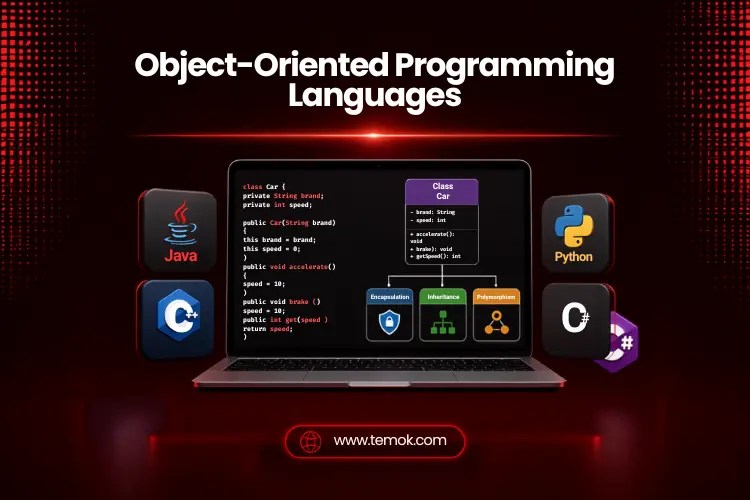
Object-oriented programming (OOP) arranges code into objects that include both data and activity.
Object-oriented programming is one of the most popular types of programming languages worldwide.
Instead of arranging software around processes, OOP designs programs around objects that include both data and functionality.
This strategy enables developers to create huge applications that are easier to manage and grow.
Examples of Object-Oriented Programming Languages:
Some of the most common software development languages in this category are:
- Java
- C++
- C#
- Python
These languages underpin several corporate applications, websites, mobile apps, and enterprise systems.
Characteristics:
Object-oriented languages typically include:
- Classes and objects
- Encapsulation
- Inheritance
- Polymorphism
- Reusable code structures
Advantages:
- Easier to handle huge and complicated codebases
- Code reuse minimizes duplication and development time
- A natural match for simulating real-world systems
- Facilitates team cooperation on huge projects
Limitations:
Despite its advantages, OOP has certain drawbacks:
- Can add needless complexity to minor tasks
- Needs careful design to avoid overengineering
- Deep inheritance structures can make code difficult to comprehend
- Object creation may increase memory overhead.
- Some developers consider OOP less adaptable for specific issue types.
Use Cases:
Object-oriented languages are widely used for:
- Enterprise applications
- Banking software
- CRM platforms
- Desktop software
- Mobile applications
- Large web platforms
Many organizations choose OOP because it supports long-term growth and maintainability.
3. Functional Programming Languages
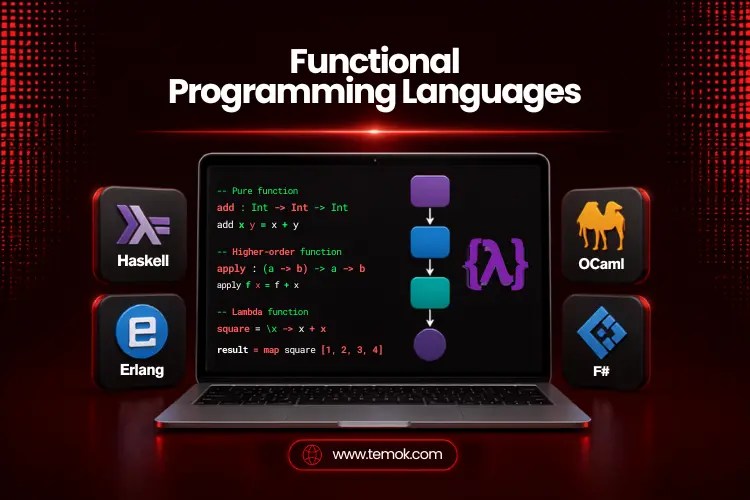
Functional programming views computing as the evaluation of mathematical functions. It prevents changes in state and mutable data, making applications more predictable and testable.
Instead of continually changing variables, functional programming prioritizes deterministic and mathematical methods in software creation.
Examples of Functional Programming Languages:
Popular examples include:
- Scala
- Erlang
- Haskell
- Elixir
- F#
Many modern coding skills also incorporate functional programming features, including Python, JavaScript, and Kotlin. Therefore, it is one of the best types of programming languages.
Characteristics:
Main characteristics of functional programming typically include:
- Pure functions
- Immutable data
- Function composition
- Reduced side effects
- Predictable execution
Advantages:
Benefits include:
- Improved reliability
- Easier testing
- Better scalability
- Fewer unexpected bugs
- Strong support for concurrent systems
Limitations:
Functional programming has various challenges:
- It might be challenging for novices to learn
- It may not feel as obvious as imperative styles
- Some functional notions involve a high learning curve
- Debugging might be more challenging for those new to the paradigm
- Not necessarily the best option for simple application logic
Use Cases:
Functional programming is often used for:
- Financial systems
- Telecommunications
- Distributed computing
- High-availability platforms
- Data processing applications
Functional programming will become more significant in 2026 as teams create distributed systems and concurrent applications based on its concepts. Modern languages, such as Kotlin, Scala, and JavaScript, make extensive use of functional characteristics.
This guide to functional programming languages provides in-depth coverage of the most popular alternatives in this area. Read this guide to get more valuable insights.
4. Scripting Languages

Programmers utilize scripting languages to automate tiring operations, manage dynamic online content, and support processes inside bigger applications. They are usually interpreted rather than compiled, making them quicker to create and test.
Unlike certain traditional compiled types of programming languages, scripting languages frequently run code directly via interpreters.
Examples of Scripting Languages:
Common scripting languages include:
- JavaScript
- PHP
- Python
- Perl
These languages are used extensively across modern digital platforms.
Characteristics:
Key characteristics of scripting programming languages are:
- Interpreted at runtime instead of being compiled
- Faster to write and iterate than compiled languages
- Frequently used to automate monotonous chores
- Integrated with web browsers, dedicated servers, or an operating system
Advantages:
Benefits include:
- Faster development cycles
- Easier automation
- Reduced complexity
- Strong community support
- Extensive libraries and frameworks
Limitations:
Scripting languages do have various limitations:
- Typically slower than compiled languages
- May not be suitable for performance-critical systems
- It can be tough to sustain in really big projects
- Runtime errors may occur solely during execution
- Security issues may develop if scripts are not adequately verified
Use Cases:
- JavaScript manages all dynamic behavior in web browsers and supports backend development via Node.js.
- PHP continues to power approximately 75% of all websites with server-side backend development, including WordPress.
- Python is the chief programming language for automation, data processing, and system management.
- DevOps teams make considerable use of Python and Bash scripting for deployment pipelines and infrastructure automation.
Learn more about the top 10 scripting languages you must learn for better software development.
5. Logic Programming Languages

Instead of instructing a computer what to do, a logic programming language communicates a set of facts and rules that teach the machine how to make judgments. Therefore, these types of programming languages are best for research projects.
Examples of Logic Programming Languages:
Some examples of logic languages include:
- Prolog
- Absys
- Datalog
- Alma-0
Characteristics:
Key characteristics include:
- Based on formal logic and inference
- Describes relationships and norms, rather than methods
- The runtime engine searches for solutions automatically
Advantages:
Benefits include:
- Strong problem-solving capabilities
- Efficient reasoning systems
- Useful for AI research
- Flexible decision-making models
Limitations:
Logic programming has certain limitations, such as:
- Not commonly used in mainstream software development
- For developers familiar with imperative languages, it might be tough to learn
- Large-scale general-purpose applications may have performance limitations
- Debugging logic rules may be tricky
- Tooling and community support are frequently smaller than in popular languages
Use Cases:
Logic programming is often used for:
- Expert systems
- Knowledge-based systems
- Research projects
- Decision support systems
- Artificial intelligence experiments
6. Declarative Programming Languages
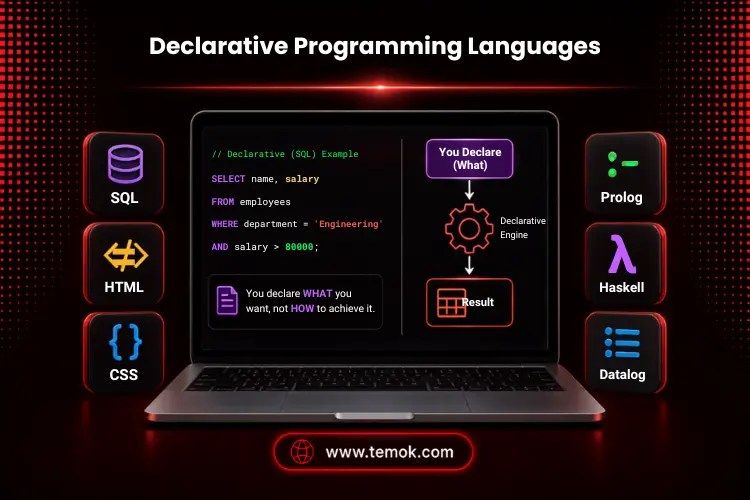
Declarative programming specifies the desired result without defining how to get there. The system or engine that interprets the code handles the implementation specifics.
Developers provide the intended outputs, and the system handles the execution details automatically. This method can minimize programming complexity while improving readability compared to other types of programming languages.
Examples of Declarative Programming Languages:
Examples include:
- SQL
- XQuery
These languages are frequently utilized in database and data processing contexts.
Characteristics:
Key characteristics of declarative programming languages include:
- Describes intended results rather than step-by-step instructions
- High degree of abstraction from implementation details
- Typically domain-specific rather than general-purpose
Advantages:
Benefits include:
- Faster development
- Easier maintenance
- Better abstraction
- Reduced complexity
Limitations:
Declarative programming does have several drawbacks, such as:
- Reduced control over execution details
- It can be more difficult to tune manually
- Not appropriate for many types of application logic
- Performance optimization may rely largely on the underlying engine
- Limited flexibility as compared to lower-level programming techniques
Use Cases:
Declarative programming is commonly used for:
- Database management
- Data querying
- Information retrieval
- Reporting systems
- Business intelligence platforms
Also Read: Modern Web Applications: How They Handle Thousands of Concurrent User Actions Without Breaking
Major Differences Between Programming Language Types
While all types of programming languages assist developers in creating software, each category tackles issue resolution differently.
The following comparison table discusses the main differences:
| Type | Focus | Examples | Best For |
|---|---|---|---|
| Procedural Programming | Step-by-step instructions | C, Pascal, BASIC | System software |
| Object-Oriented Programming | Objects and reusable code | Java, C++, C#, Python | Enterprise applications |
| Functional Programming | Functions and immutability | Haskell, Lisp, Erlang, F# | Scalable systems |
| Scripting Languages | Automation and rapid development | JavaScript, PHP, Python, Perl | Web applications |
| Logic Programming | Rules and reasoning | Prolog, Datalog | Expert systems |
| Declarative Programming | Desired outcomes | SQL, XQuery | Databases and analytics |
Understanding these distinctions enables web developers to select the right language category depending on project needs, performance expectations, and business objectives.
Most Popular Programming Languages in 2026
While studying the many types of programming languages is vital, many developers want to know which languages currently dominate the business.
Community support, programming career possibilities, corporate adoption, learning resources, and future development potential are all common factors that impact a language’s popularity.
In 2026, numerous programming languages will continue to dominate the market for software development, web development, application development, cloud computing, artificial intelligence, online applications, and business systems.
Here are the most popular types of programming languages and their uses in 2026:
Python
Python is still one of the most popular and adaptable computer programming languages in the world.
Its simple syntax and user-friendly design make it accessible to new developers, but its expansive ecosystem entices huge organizations and technology companies.
Python is also the most beginner-friendly language, with a clean, legible syntax that closely resembles natural English, making it the ideal starting point for the majority of software developers.
Why is Python Popular?
Key reasons include:
- Easy to learn
- Massive developer community
- Extensive libraries
- Strong AI ecosystem
- Cross-platform compatibility
Common Uses:
Python is widely used for:
- Artificial intelligence
- Machine learning
- Data science
- Automation strategies
- Web development
- Backend services
In 2026, Python remains one of the safest language investments for both novices and pros.
JavaScript
A discussion on programming language types would be incomplete without including JavaScript.
JavaScript drives the interactive web and is still necessary for current web development. Almost every significant website employs JavaScript in some fashion.
It is accessible with any browser. Every website makes use of it. TypeScript overtook Python as the most popular language on GitHub in August 2025, with over 42,000 contributors.
Why is JavaScript Popular?
Benefits include:
- Runs in all major browsers
- Large ecosystem
- Massive community support
- Full-stack development capabilities
- Strong framework ecosystem
Common Uses:
JavaScript is heavily used for:
- Frontend development
- Backend development
- Web applications
- Single-page applications
- Real-time systems
If your objective is to create websites or web-based products, JavaScript is still a must-know language.
Java
Java is utilized by 30% of professional developers and ranks third on TIOBE, with an 8.84% share.
Java enables corporate application development in banking, insurance, telecommunications, and logistics. It is the foundation of Android mobile app development thanks to its partnership with Kotlin, and it is still firmly ingrained in large-scale corporate systems that will not be traded anytime soon. That is why it is still one of the best types of programming languages.
Why is Java Popular?
Organizations value Java because of:
- Platform independence
- Mature ecosystem
- Strong security features
- Excellent scalability
- Enterprise-grade performance
Common Uses:
Java is commonly used for:
- Enterprise software
- Banking systems
- Business applications
- Android applications
- Large-scale backend systems
Despite the introduction of other languages to the market, Java remains a cornerstone of corporate technology.
C++
C++ continues to play an important role in performance-intensive computing. It gives developers direct control over system resources while retaining object-oriented functionality.
Unreal game engines, financial trading platforms, aeronautical software, and automobile systems all use C++. It remains the language of choice when raw performance is unavoidable.
Why is C++ Popular?
Advantages include:
- Exceptional performance
- Low-level hardware access
- Efficient memory management
- Strong portability
- Long-term industry adoption
Common Uses:
C++ is frequently used for:
- Game development
- Operating systems
- Embedded systems
- Real-time applications
- Financial trading platforms
Developers who need maximum performance often go for C++.
Go
Google built Go to be simple, fast, and concurrency-friendly. It is the preferred language for cloud computing infrastructure, microservices, and DevOps tools. Go demand increased by 41%, making it one of the fastest-growing languages for employment in 2026.
Docker, Kubernetes, and Terraform are all Go-based, demonstrating the language’s dominance in cloud-native software development. A Go software engineer may earn $120,000 to $180,000 per year in the United States.
Why is Go Popular?
Organizations appreciate Go because it offers:
- Simple syntax
- High performance
- Fast compilation
- Strong concurrency support
- Excellent cloud capabilities
Common Uses:
Go is widely used for:
- Cloud services
- Distributed systems
- APIs
- Infrastructure tools
- DevOps platforms
Go’s popularity grows in tandem with cloud-native technology.
Rust
Rust has been one of the most liked types of programming languages for nine years in a row, with developers admiring it 72% of the time.
Rust has emerged as one of the most widely debated languages in modern software engineering. It prioritizes safety, dependability, and performance without compromising speed.
Why is Rust Popular?
Key advantages include:
- Memory safety
- High performance
- Reduced security vulnerabilities
- Strong concurrency support
- Modern language design
Common Uses:
Rust is increasingly used for:
- Systems programming
- Cloud infrastructure
- Security-focused applications
- Embedded systems
- High-performance software
Many experts believe Rust is one of the most promising languages for the future.
TypeScript
Microsoft created TypeScript, a typed superset of JavaScript. It provides static type checking to JavaScript, which detects mistakes before they reach production.
Modern frameworks like Next.js and Angular now bootstrap projects in TypeScript by default, and generative AI has boosted adoption even further, resulting in over 1 million additional contributors by 2025, a 66% year-over-year rise.
In 2026, TypeScript will be the professional standard for frontend developers and large-scale web development teams.
Why Is TypeScript Popular?
Developers prefer TypeScript because it offers:
- Better code quality
- Improved scalability
- Strong tooling support
- Easier maintenance
- Enhanced developer productivity
Common Uses:
TypeScript is commonly used for:
- Enterprise web applications
- Frontend frameworks
- Backend services
- SaaS platforms
- Large-scale software projects
Its quick popularity has made it one of the most valued developer talents by 2026.
Best Programming Languages by Use Case
Choosing the correct language is frequently determined by the type of project you intend to create.
Different projects have varied needs, and certain languages are inherently better in some areas. Here are the best types of programming languages as per use cases:
| Use Case | Best Language |
|---|---|
| Web Development (Frontend) | JavaScript, TypeScript |
| Web Development (Backend) | Python, Go, PHP |
| AI and ML | Python |
| Mobile App Development (Android) | Kotlin |
| Mobile App Development (iOS) | Swift |
| Enterprise Application Development | Java, C# |
| Systems Software Development | Rust, C |
| Game Application Development | C++ |
| Cloud Computing and DevOps | Go, Python |
| Data Science | Python, R, SQL |
| Automation Scripting | Python, JavaScript |
Also Read: How To Make a Social Media App: Smart Strategies For Modern App Development
How To Choose The Right Programming Language?

Many beginners make the mistake of looking for one “best” language. In truth, the optimal language depends on your objectives. Here are the steps to choose one of the best types of programming languages:
Learning Curve
Python and JavaScript have the smoothest learning curves. Rust and C++ are substantially harder for novices. If you want to start constructing rapidly, start with Python or JavaScript and progress to other languages as your coding abilities improve.
Project Requirements
Match the terminology with the problem. Web development requires JavaScript or TypeScript. Data science requires Python. Mobile app development requires Kotlin or Swift. System work requires Rust or C. Using the incorrect language for a project causes friction that grows over time.
Performance Needs
Rust, C, or C++ are ideal for memory-intensive, high-performance tasks. Python and JavaScript are significantly more productive in quick application development when development speed is more important than raw execution performance.
Community Support
A language’s ecology is as important as its characteristics. Python, JavaScript, and Java have the most active communities, tutorials, libraries, and Stack Overflow inquiries.
Large communities provide:
- Tutorials
- Documentation
- Frameworks
- Libraries
- Career opportunities
Career Opportunities
Python and JavaScript provide the most total computer programming jobs. Because of the scarcity of developers, Rust and Go offer fewer employment opportunities but at a higher wage. Match your language of choice to your real programming career ambitions.
Best Programming Languages for Beginners
If you’re new to coding, selecting the correct language might make the process easier and more pleasant.
Many novices spend too much time comparing different types of programming languages rather than learning how to start coding. The reality is, your first language is only a starting point.
Understanding the foundations makes learning other programming languages much easier.
Python is the ideal first language for most beginners because:
- Its syntax reads like simple English
- It has applications in artificial intelligence, data science, automation, and web development
- The largest job market in any language
- The community generates the greatest learning resources
JavaScript is the best first language for web development because:
- You may see results in the browser instantly
- Every website uses it, keeping real-world practice consistent
- It leads directly to full-stack web development skills with TypeScript.
Scratch is an excellent starting point for younger students or complete beginners who have never written code. It introduces different types of programming paradigms visually before introducing text-based syntax.
Language hopping is the most common beginner’s mistake. Choose one language. Spend 90 days on it. Create three small projects. Then consider whether to add another.
Future Trends in Programming Languages
Emerging trends are shaping the future of different types of programming languages as technology continues to grow rapidly.
Understanding these patterns might help developers make more informed learning and career decisions.
1. AI-Assisted Development
Artificial intelligence is readily transforming the software development process.
Modern AI-powered coding assistants can:
- Generate code
- Detect potential errors
- Suggest improvements
- Automate repetitious activities
Rather than displacing developers, AI is helping programmers become more productive.
Developers who combine great coding abilities with AI-assisted technologies will certainly have a competitive advantage in the next few years.
2. Rust Adoption Continues To Grow
Rust has acquired substantial popularity because of its focus on performance and security.
Many firms are embracing Rust for:
- Infrastructure software
- Cloud services
- Security-critical systems
- High-performance applications
As cyber risks continue to escalate, Rust’s safety-focused architecture makes it increasingly desirable.
3. TypeScript Growth
TypeScript is becoming increasingly used in contemporary online apps.
Many development teams now prefer TypeScript to plain JavaScript because it reduces errors and increases maintainability.
The demand for TypeScript expertise among startups and enterprises continues to grow.
4. Cloud-Native Development
The rise of cloud computing is impacting language adoption.
Languages commonly used in cloud-native environments are:
- Go
- Python
- Java
- TypeScript
- Rust
As businesses migrate infrastructure to the cloud, the demand for cloud-focused development skills grows.
5. Low-Code And No-Code Platforms
Low-code tools make software development more accessible.
These platforms enable developers to create mobile and web applications with minimal coding knowledge.
Traditional software development languages, on the other hand, are still required for the creation of complex and scalable applications.
Rather than replacing web developers, low-code platforms frequently augment traditional development workflows.
Common Mistakes When Choosing a Programming Language
Many individuals select different types of programming languages for incorrect reasons. Avoiding these complex mistakes can save you a lot of time and stress. Here are some of the common mistakes individuals make while choosing a programming language:
- Following trends blindly. Every year, a new language receives notice. Learning whatever is in trend without knowing why results in superficial coding abilities that do not transfer. Learn the principles of a category first, and then select a language within that area.
- Ignoring project requirements. Choosing Python as the best game engine because you are already familiar with it is like using a hammer to spin a screw. Match the tool to the job, not to your comfort level.
- Choosing based only on salary. Rust pays well; if you dislike system software development, the compensation will not compensate for the mismatch. Choose depending on the type of work you want to undertake on a daily basis, and then make sure the job pays what you need.
- Learning syntax instead of concepts. Programming principles are transferable between languages. A developer who is well-versed in object-oriented programming may learn a new language in a matter of weeks. Someone who has only learned Python syntax will struggle with each new language they encounter.
FAQs (Frequently Asked Questions)
What Are Programming Languages?
Programming languages are organized systems that transmit instructions to computers. They enable developers to build software, websites, apps, and automated processes.
What Are The Types Of Programming Languages?
The amount of abstraction from the hardware and the programming paradigms (how code is structured) is the primary type of programming language.
Which Programming Language Is Best?
There is no single optimal language for all purposes. Python is frequently suggested for novices and AI development, although JavaScript remains indispensable for web programming.
What Is The Difference Between Programming Language Types?
Different language types use different programming paradigms. Some concentrate on methods, while others consider objects, functions, rules, or intended outcomes.
Which Programming Language Should Beginners Learn?
Python is usually regarded as the greatest programming language for novices because of its clear, intuitive syntax, which reads similarly to standard English.
What Are Functional Programming Languages?
Functional programming languages are intended to approach computation as the evaluation of mathematical functions.
Which Language Is Best For AI Development?
Python’s large machine learning and data science ecosystem makes it often regarded as the ideal language for AI development.
Which Language Is Best For Web Development?
JavaScript is commonly regarded as the greatest and most necessary language for web development. Moreover, it is the only programming language that runs natively in all major web browsers, making it an essential tool for frontend development.
What Are The 4 Types Of Programming Languages?
The four major types of programming languages are procedural languages, Object-Oriented languages, functional languages, and scripting languages.
What Are The 10 Main Programming Languages?
The 10 main programming languages are:
- Python
- JavaScript
- Java
- C++
- C#
- Swift
- TypeScript
- Kotlin
- Rust
- Go
What Are The 12 Examples Of Computer Programming Languages?
Examples include:
- Python
- JavaScript
- Java
- C++
- C#
- Go
- Rust
- TypeScript
- PHP
- Kotlin
- Swift
- SQL
What Are The Major Types Of Programming Languages?
The major categories are:
- Procedural programming languages
- Object-oriented programming languages
- Functional programming languages
- Scripting languages
- Logic programming languages
- Declarative programming languages
Conclusion
Understanding the various types of programming languages is essential for making sound software development decisions.
When you understand that procedural, object-oriented, functional, scripting, logic, and declarative programming languages all handle distinct types of problems, every language suggestion you hear begins to make sense.
In 2026, it is evident which languages stand out. Python for AI, data science, and novices. For web development, we use JavaScript and TypeScript. Java for corporate application development. Rust is suitable for secure system software development. Go for cloud computing and DevOps. For mobile app development, use Kotlin and Swift.
Choose the category that best fits your aims. Select the language that leads in that category. Create something genuine with it.
Nadiia Kehrli
Hey, Hanna. Thank you for the input. Could you please clarify, if this is the complete list of programming languages or only a part of it? How often do new programming languages appear?
David Max
Nadiia, Thanks for your appreciation. We have discussed the major classifications and types of computer programming languages. When we talk about OOP (Object Oriented Programming) then hundreds of languages are fall in this category.