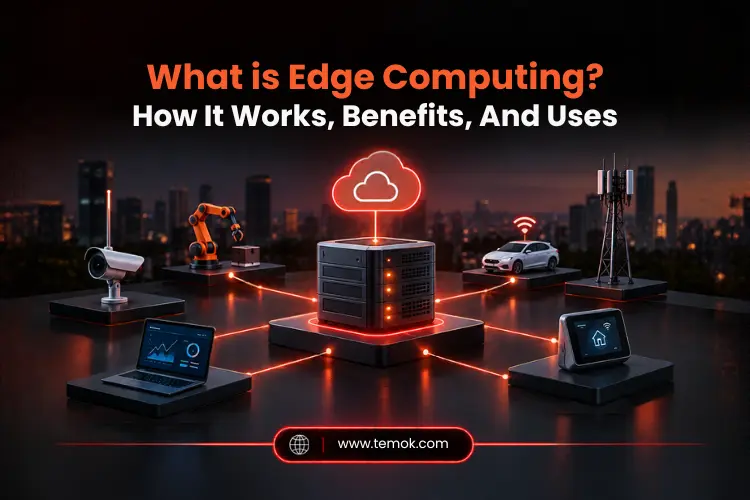

Edge computing is the practice of processing and storing data closer to its original source, rather than sending it all to a centralized cloud server or data center first. This improves application response time, reduces network traffic, and enables real-time decisions.
Understanding what is Edge Computing is becoming more important as organizations implement interconnected devices, smart gadgets, and artificial intelligence in 2026. Edge computing, which includes factory sensors and smart cameras, allows systems to process information closer to where it is required.
This guide will explain edge computing definition, edge computing architecture, edge computing benefits, how it differs from traditional cloud computing and much more. So, keep reading and exploring to learn the key edge computing meaning deeply.
Key Takeaways
- Edge computing powerfully processes data closer to its origin instead of sending everything to a separate distant cloud server.
- Lower latency, less network traffic, and enhanced local operation are the primary edge computing advantages.
- It is frequently utilized when speed, bandwidth efficiency, or local control take precedence over relying solely on a centralized system.
- Common edge computing applications include IoT devices, manufacturing, healthcare, smart towns, and edge AI.
- Edge servers present hardware, security, and maintenance problems that enterprises have to plan for.
What is Edge Computing?
Edge computing is a decentralized computing strategy that processes data close to where it is created, rather than sending it all to a distant cloud or data center.
In simpler terms, edge computing implies doing more computing close to the source of the data rather than sending it to the cloud first. Edge computing allows you to process part of the data generated by a camera, sensor, machine, or device locally.
For example, a security camera may analyze video footage locally and send out an alarm if it identifies unusual activity. It is not necessary to upload every second of footage to a distant server for analysis, thanks to edge devices.
After understanding what is edge computing, you must know how it actually works. Our next section will cover how does edge computing work and its key components.
How Does Edge Computing Work?
Edge computing works when an edge device gathers data, nearby computing resources analyze it, and finally the system responds and sends precise data to another location.
Unlike cloud computing, which relies on distant access to computing resources such as storage, computing, and networking over the internet, edge computing processes data locally where it is collected by devices. Edge computing, while completely different, extends cloud model services to edge locations.
A typical edge process might include:
- Devices, sensors, or machines that produce data.
- Local edge systems gather and process the data.
- Real-time actions or assessments made near the source.
- Selected data is forwarded to centralized systems for storage, coordination, or more comprehensive analysis.
Key Components of Edge Computing Architecture
Key components of edge computing architecture include edge devices, edge gateways, edge servers, network connections, and the cloud or data center.
- Edge devices: They include cameras, sensors, machines, and other data-collecting devices.
- Edge gateways: They are systems that interconnect devices while filtering/processing information.
- Edge servers: These are nearby computers that execute apps and handle heavy workloads.
- Network connections: Wired or wireless connections exist between devices and computing systems.
- Cloud or data center: It is a centralized infrastructure for large-scale computation, storage, and analysis.
These components work together to allow enterprises to process urgent information locally while assigning tasks that require more computing power to centralized systems. Therefore, understanding what is edge computing has become necessary for businesses before they integrate it with their business processes.
What Are The Benefits of Edge Computing?
The primary edge computing advantages include faster responses, lower latency, better decision-making, lower bandwidth usage, lower IT costs, boosted reliability, and greater data control over the information where it is processed.
Faster Processing and Lower Latency
Edge computing bypasses centralized cloud and data center sites, allowing businesses to handle data more rapidly and reliably. Latency refers to the time it takes for data to travel for a system to respond. Edge computing reduces internet latency by processing information closer to its source.
Optimized Decision-Making
Data analytics at the network’s edge allows for faster access to information. Organizations may now use AI/ML data and complex algorithms to improve real-time decision-making and maximize consumer experiences, as shown in customized shopping.
Reduced Bandwidth Usage
IoT applications create massive volumes of data. The expense of transferring this data to the cloud might rapidly become prohibitive. Processing and storing data at the edge reduces the quantity of data transferred over the network, lowering bandwidth use and cloud storage expenses.
Reduced IT Expenses
Businesses may cut IT costs by processing data locally rather than on the public cloud. Unnecessary data is filtered away at or near the collection point before being transferred to the cloud, lowering cloud transmission, processing, and storage costs. This is the major benefit when understanding what is edge computing in detail.
Enhanced Reliability
Edge apps can continue to execute specific activities during an internet outage, provided the appropriate computer resources and data are accessible locally. This is important in remote sites and areas with poor connectivity.
Data Control
Local processing can also limit the amount of sensitive data transmitted elsewhere. However, edge computing does not inherently provide security. Devices still require software upgrades, access restrictions, encryption, and monitoring.
Data Sovereignty
Organizations must follow the data sovereignty rules of the nation or area in which they collect, process, keep, and use consumer data. Moving data to the cloud across national boundaries might make it harder to comply with these regulations. Edge computing allows organizations to verify that they are following local data sovereignty standards by processing and storing data within their borders.
What Are The Disadvantages of Edge Computing?

Edge computing disadvantages include increased deployment complexity, distributed security threats, maintenance requirements, and restricted computing power in some places. Businesses should compare these disadvantages with the advantages of faster local processing.
One disadvantage of edge computing is that it may expand attack paths. The introduction of additional “smart” devices, such as edge servers and IoT smarter devices with powerful built-in processors, creates new potential for malevolent attackers to corrupt these devices.
Unlike a centralized cloud system, edge computing infrastructure may include a large number of devices and local servers distributed across several locations. Every system requires configuration, monitoring, upgrades, and protection.
Security is another concern. A device located in a public or remote location may be more physically accessible. If it is not adequately protected, attackers may exploit it.
This is why learning what is edge computing and IoT solutions are often includes infrastructure design and operational management.
Also Read: IoT Use Cases: Smart Solutions For Enterprise and Industrial Automation
Edge Computing Vs Cloud Computing: What’s the Difference?
Edge computing handles data close to its source, whereas cloud computing employs faraway data centers to provide processing, storage, and software solutions. Many current systems integrate both techniques rather than selecting just one.
For a better understanding of the difference between what is edge computing and cloud computing, follow the table below:
| Feature | Edge Computing | Cloud Computing |
|---|---|---|
| Processing Location | Near the data source | Remote data centers |
| Response Time | Often lower for local tasks | Depends on the network and service distance. |
| Network Use | Can reduce data transfers | Data may need to be sent to the cloud. |
| Computing Resources | May be limited at each location | Can scale over huge infrastructures. |
| Common Uses | Real-time monitoring and local control | Large-scale analytics, storage, and applications. |
| Connectivity | Some tasks can work offline. | Cloud services often require a connection. |
For example, a manufacturing plant may employ edge servers to detect machine faults right away while transmitting summarized data to the cloud for long-term investigation.
The ultimate choice depends on the workload. Edge computing is excellent for making quick local choices, whereas cloud computing is better suited to centralized administration and resource-intensive operations. Combining them allows for a workable balance of speed, scalability, and cost.
What Are the Common Edge Computing Applications and Use Cases?
Common edge computing use cases include edge devices, healthcare, retail, industrial automation, smart cities, monitoring, and real-time AI. These use cases are useful when data must be processed fast or cannot always be forwarded to a central server.
Here is a breakdown of the most common, yet powerful edge computing applications and use cases you must know to fully understand what is edge computing meaning:
1. Healthcare
In healthcare, edge computing enables remote patient monitoring and medical imaging. Processing patient data locally minimizes latency and helps secure sensitive health information, which supports standards such as HIPAA.
2. Edge Computing and IoT
Edge computing and IoT are crucial because Internet of Things devices create massive volumes of data via sensors and linked equipment.
A smart thermostat, for example, can monitor room temperature and regulate heating or cooling accordingly. Similarly, agricultural sensors can monitor soil conditions and initiate irrigation as needed.
Processing chosen data near these devices minimizes network traffic and allows for faster decisions.
3. Financial Services
Banks and financial institutions employ edge computing to provide real-time fraud detection, low-latency transactions, and localized data processing that fulfills data sovereignty and compliance needs in several areas.
4. Retail
A big retailer monitors client movement patterns, inventory levels, and checkout times in 1,200 shops. Edge computing translates this data into rapid actions, allowing digital signage to update immediately, employees to know when and where to refill popular products, and checkout systems to create extra lanes during long waiting times.
5. Smart Cities
Smart cities can use edge technologies to analyze data from traffic cameras and control local traffic lights. Retailers could manage inventory data and monitor equipment across multiple stores.
Also Read: Cluster Computing vs Cloud Computing: Understanding Their Role in Modern IT
6. Edge AI and Real-time Analytics
Edge AI combines edge computing with artificial intelligence, enabling AI models to operate on devices or neighboring computer systems.
As AI workloads increase, edge processing can provide quicker answers while reducing data transfers. However, complicated models may still need strong servers or cloud resources for training and large-scale analysis. It is worth understanding what is edge computing before using this application.
7. Industrial Automation
Edge computing serves as the foundation for Industry 4.0 by allowing for flexible and responsive production. For example, Industrial IoT (IIoT) sensors on the manufacturing line monitor equipment wear and provide predictive analytics to determine when maintenance is necessary, lowering downtime and costs. On the manufacturing floor, near-real-time machine vision may detect errors and simplify packing procedures.
8. Entertainment
Edge computing and edge caching are used by content providers and streaming platforms to give users continuous, seamless experiences. This decreases buffering during content delivery, increases streaming quality, and enables high-demand activities like live broadcasts and online gaming.
What Are the Main Edge Computing Devices?

Edge computing devices include powerful sensors, smart cameras, enterprise controllers, payment gateways, network routers, and local servers that process critical data close to where it is created. Choosing the right device depends on your workload and the response time you require.
Simple devices can handle basic filtering and analysis. More demanding applications make use of edge servers, which have more processing power and storage.
For example, a smart camera may detect activity locally, but an edge server processes footage from several cameras throughout a facility. A gateway can link several sensors and provide chosen data to a central system.
These edge computing devices do not all serve the same purpose. Some take data, process it, and link local systems to cloud infrastructure. Together, they enable distributed computing in homes, enterprises, industries, and public infrastructure.
Our final section will cover what is edge computing AI and its future. So, let’s discuss it.
What is Edge AI?
As edge infrastructure advances, enterprises are increasingly merging it with machine learning to analyze and respond to data immediately on connected edge devices.
This strategy, known as edge AI, eliminates dependency on centralized cloud infrastructure and streamlines operations in complicated sectors (such as supply chain management and production). Unlike cloud-based methods, edge artificial intelligence solutions can run offline and are therefore ideal for uses free from a continuous internet connection.
FAQs (Frequently Asked Questions)
What are the downsides of edge computing?
The major downsides of edge computing include: increased hardware and maintenance costs, complicated management, increased security risks, and limited resources in smaller setups.
What is edge vs cloud?
The main difference between edge computing and cloud computing is where data is processed and stored: edge computing processes data locally near the source (such as IoT devices, sensors, or local gateways), whereas cloud computing processes data centrally in vast, faraway data centers accessible over the internet.
What are examples of edge computing?
Edge computing examples include autonomous vehicles, healthcare, industrial automation, smart cities, smart traffic management, telecommunications, 5G networks, etc. These systems employ local computing to make choices rather than depending on a remote server for each operation.
Is Netflix edge computing?
Yes. Besides having a hybrid model architecture, Netflix largely uses edge computing principles. Netflix utilizes a content delivery network to bring video material closer to users. This is connected to edge infrastructure since it shortens delivery distance and lowers network strain.
Conclusion
Understanding what is edge computing has become easier as it allows organizations to realize how processing data closer to its source may minimize delays, conserve bandwidth, and enable real-time applications.
Edge computing technology is continuously evolving toward more intelligence and connection. Devices are increasingly being enabled to make their own decisions with AI models that learn in real time to local conditions.
This change promises to increase performance without requiring continual reliance on the cloud, allowing for advancements such as smarter factories that anticipate maintenance needs and municipal systems that dynamically modify traffic flow.
As connected devices and AI applications become more prevalent, organizations may balance quick local processing with centralized data management by merging edge and cloud computing.