
In an organization, when a server fails badly, ransomware hits, or critical data suddenly becomes inaccessible, one question matters at that point immediately: What is RPO, and how much fresh data can an organization afford to lose? RPO (Recovery Point Objective) provides organizations with an effective way to define how far back a recovery may need to go to restore usable critical data.
Imagine your database crashes down at 6 p.m. Your last backup was at 5 p.m. That one hour of missed orders, updates, and customer data constitutes precisely the type of loss RPO is meant to measure and regulate before anything happens.
Keep reading and exploring to learn everything about recovery point objective RPO, its uses, and how it minimizes data loss and enhances data recovery.
Key Takeaways
- RPO refers to the maximum data volume an organization can afford to lose after a disaster, ransomware attack, outage, or system failure.
- A shorter RPO needs a more recent usable recovery point for system restoration.
- Different kinds of business workloads need different RPOs. A financial transaction system normally requires a much stronger RPO target than an archive system.
- Backup frequency plus replication technology directly influence whether RPO is attainable; nonetheless, RPO is a business need, not merely another word for backup schedule.
- Reducing RPO often involves more frequent backups, duplicates, or continuous data protection, all of which carry higher costs.
What is RPO (Recovery Point Objective)?
RPO, or Recovery Point Objective, refers to the maximum manageable age of data that a company is ready to lose following a disruption such as downtime, system failure, or cyber threats. This refers to the moment before a disaster when data may be effectively restored while business continuity is preserved.
In basic terms of understanding what is RPO, it actually answers one critical question for organizations: “How much fresh data can we afford to lose?”
For example, an RPO of two hours means that the recovery objective should be designed in such a way that it is no more than two hours behind the disruption.
That is the reason RPO meaning in disaster recovery is closely interconnected with allowable data loss. It offers technical teams a measurable goal rather than leaving recovery decisions to chance.
With a recovery point objective in place, an organization can:
- Back up data at appropriate intervals to simplify business continuity disaster recovery.
- Ensure that data loss never exceeds the allowed loss tolerance.
- Help companies assess how soon they can recover from a data loss due to a disaster, technological failure, or misconduct.
How Does RPO Work?
An RPO works following a simple timeline:
Last Recovery Point → New Data Created → Disruption Occurs → Data Restored
Between your last usable recovery point and the time, the disruption occurs, new data is generated that has not yet been saved in a backup or replica server. That gap signifies a potential RPO data loss window. Moreover, an RPO defines the maximum size that a window may have.
A shorter RPO requires more frequent recovery points. Depending on the workload, this may include more frequent backups, snapshots, replication, or continuous data protection.
Let’s now understand what is RPO meaning with a simple recovery point objective example.
Simple RPO Example
Consider an organization with an RPO backup goal of two hours. If a disruption occurs at 5:35 PM, its recovery strategy should strive to provide an accessible recovery point that is no older than 3:35 PM.
However, this does not imply that exactly two hours of usable data will always be lost. In fact, RPO is actually a target, not a promise that the actual data loss will be the same as the set target. Actual loss in a true downtime may be lower, depending on when the disruption occurs with respect to the latest recovery point.
Why is RPO Important in Disaster Recovery?
RPO in disaster recovery is important because it forces organizations to define acceptable data loss in advance instead of finding out the real cost during an actual crisis.
A clear RPO meaning in disaster recovery can help organizations:
- Limit bearable data loss.
- Recognize important business applications and information.
- Determine backup and replication requirements.
- Assist in disaster recovery planning.
- Prioritize recovery investments.
- Reduce operating disruptions following an event.
Moreover, without a specified disaster recovery RPO, recovery decisions take place under pressure during an outage, usually resulting in worse results and more data loss than necessary.
After understanding what is RPO and its importance, let’s discuss how to calculate it for better results.
Also Read: Acronis Cyber Protect Cloud: Why Temok Stands Out in Cyber Security Solutions
How To Determine the Right RPO?
The proper RPO is mostly determined by business impact, acceptable data loss, and the skills required to achieve the objective. It should not be picked just because a backup product provides a certain schedule.
Here are the steps involved in determining what is RPO that is right:
1. Identify Critical Data and Applications
First, begin by listing the systems that generate, store, and process critical business information. Consider different types of databases, customer records, financial systems, websites, email, apps, file servers, and other workloads. Not all systems deserve the same recovery goal.
2. Evaluate the Impact of Data Loss
Consider the consequences of losing data from the previous hour, day, or week for each system. Consider the financial implications, operational interruption, customer trust, compliance requirements, and lost productivity.
3. Determine How Much Data Loss Is Acceptable
Determine if the business workload is capable of dealing with minutes, hours, or longer periods of possible data loss. This is the core strategy of how to calculate RPO. Moreover, the solution should be based on business requirements, not technological preferences. A vital payment system and a static document repository may serve fundamentally different purposes.
4. Assess Backup and Replication Capabilities
You must review your organization’s infrastructure with honesty after one target is established. Determine whether the real infrastructure can create accessible recovery points frequently enough.
For example, a particularly short target may need more than standard nightly backups. It might need regular snapshots, replication, or ongoing protection.
5. Balance RPO Requirements With Cost
Very tight RPO in backup targets necessitate more frequent backups, continuous replication, and extra infrastructure. A near-zero RPO for each system is rarely achievable or cost-effective. Adjust the investment to reflect the real commercial value of each assignment. Moreover, it is an important point when discussing what is RPO in detail.
6. Test and Review the RPO
Regularly verify that your data recovery process can possibly achieve the RPO you have set. This is because an RPO that looks achievable on paper but an organization never tests is a real risk. Furthermore, testing also allows organizations to determine if the actual recovery environment is keeping up with the projected RPO backup frequency.
RPO Examples For Different Workloads
RPO requirements fluctuate greatly depending on workload. The examples below are just for illustration purposes and do not constitute general suggestions.
| Workload | Example RPO | Reason |
|---|---|---|
| Financial Transaction System | Minutes | Data may change continually |
| E-commerce Database | 15 to 60 minutes | Orders and client activity are vital |
| Business Email | 1 to 4 hours | Communication data changes often |
| Internal Business Application | Several hours | Business effect varies |
| Archive Data | 24+ hours | Data could update less regularly |
The above-mentioned examples are only illustrative ones so that you can better understand what is RPO or recover point objective example for different workloads. However, businesses should determine their RPO as per their own authentic data loss tolerance and recovery capabilities.
What Factors Affect Recovery Point Objective?

Numerous technical and business factors affect recovery point objectives, such as data criticality, frequency of data changes, data loss cost, backup and replication technology, and storage infrastructure.
Data Criticality
Highly critical data normally deserve stricter recovery objectives. For example, a customer’s financial transaction database may need RPO every few minutes, while the older reference files may have the capability to tolerate a longer recovery window.
Frequency of Data Changes
Organizational systems that generate non-stop transactions, such as payment processing, need much shorter RPOs than relatively static data like archived records or reference tables.
Cost of Data Loss
The financial and operational repercussions of lost knowledge should influence the recovery objective. If losing only half an hour of critical data can cost thousands of dollars or cause inconvenience to customers, investing in periodic protection may be worthwhile.
Backup and Replication Technology
Regular full backups, incremental backups, data snapshots, and continuous replication all generate recovery points in different ways and at different rates. The technology available directly influences what is RPO is possible. Moreover, daily backups provide only a 24-hour RPO at best. However, continuous replication allows for RPOs measured in seconds.
Storage and Infrastructure
Storage capacity, network bandwidth, computing power, and recovery design are also important. A protective system must be capable of quickly transporting and storing data in order to maintain the necessary recovery points.
How Do Backups And Replication Help Meet RPO?
Backups and replication are technical ways of meeting a set RPO, but RPO is a business need, not just another term for a backup plan. The appropriate technique is determined by how rapidly data changes and how much damage the firm can endure.
Backup Frequency And RPO
More frequent recovery points typically enable shorter RPO objectives. If backups occur every three hours, your optimal RPO is three hours. If you require a one-hour RPO, you must use backups or another mechanism that runs at least that often.
However, the link between RPO vs backup frequency is not one-to-one. Backup frequency is one lever you may use to satisfy an RPO. On the other hand, RPO is determined right away, depending on the business impact. The backup frequency is then adjusted to accommodate it.
Replication and Continuous Data Protection
For workloads that require considerably quicker recovery times than periodic backups can offer, replication and continuous data protection keep a near-real-time duplicate of data on different infrastructure. This enables RPOs measured in seconds or minutes rather than hours, at a greater infrastructure cost.
Also Read: Protecting Your Online Presence: The Importance of Domain Takedown in Digital Brand Management
How To Reduce RPO and Minimize Data Loss?
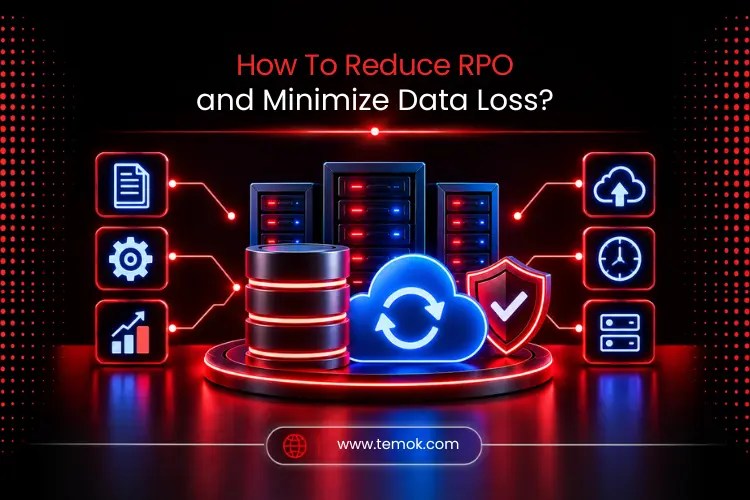
Reducing RPO usually means generating more recent and reliable recovery points for the data workloads that matter the most. You can reduce RPO and minimize data loss by increasing backup frequency, using data replication, considering continuous data protection, prioritizing critical workloads, and testing backup and recovery regularly.
To deeply understand what is RPO, you must know how to reduce it and prevent huge data loss. So, here are the steps involved in reducing RPO.
Increase Backup Frequency
You must create data recovery points periodically for critical workloads. This is because a system that is protected every hour normally has more fresh recovery points than one protected once per 24 hours.
Use Data Replication
Undoubtedly, data replication can effortlessly maintain a fresher copy of an organization’s critical data on a different infrastructure. Moreover, doing this will surely help organizations reduce the huge gap between the most recently accessible data copy and the moment a downtime or disruption occurs for better database security.
Consider Continuous Data Protection
For the most critical data workloads, continuous or almost-continuous protection detects changes as they take place, rather than at periodic intervals, significantly reducing the potential loss window.
Prioritize Critical Workloads
Never apply a strict RPO to every application automatically. The best strategy is to categorize workloads as per the business importance and assign the RPO targets accordingly. Therefore, you must prioritize critical workloads first.
Test Backup and Recovery Regularly
Validate the legitimacy and actual restorable status of the recovery points. A backup that fails the first time you try to recover it is a backup that defeats the purpose of having an RPO in the first place.
RPO vs RTO: What is the Difference?
RPO focuses on how much recent data can be lost, while RTO focuses on how quickly the affected system needs to be restored. They work together but measure different parts of recovery.
Understanding what is RPO vs RTO is important because most of the startups are unaware of the major differences between the two. For your better understanding, see the table below:
| RPO | RTO |
|---|---|
| Focuses on Tolerable Data Loss | Focuses on acceptable downtime |
| Looks at the Recovery Point | Looks at recovery time |
| Affects Backup and Replication Strategy | Affects repair and recovery method |
RPO asks how much data you can afford to lose. RTO asks how soon you need your service restored. Both are critical components of a comprehensive disaster recovery strategy, and they are often implemented jointly for each system.
Also Read: RTO vs RPO: Key Differences in Disaster Recovery Explained
Frequently Asked Questions About RPO
What Does RPO Stand for in Business?
In business, RPO stands for Recovery Point Objective, which defines the maximum data loss volume, measured in time, that a business can tolerate after a system failure, disruption, or disaster.
What Do You Mean by RPO?
RPO is the point in time at which data must be recoverable following a disturbance. If your RPO is 30 minutes, your recovery method must be capable of restoring data from no more than 30 minutes before the issue occurred.
What Does RPO Stand for in Healthcare?
In healthcare IT and disaster recovery RPO planning, RPO stands for Recovery Point Objective. Healthcare businesses frequently seek very tight RPOs for patient records and clinical systems since data loss has a direct impact on patient care and regulatory compliance.
What Does RPO Mean in Tech?
In technology, RPO stands for Recovery Point Objective. It is a recovery planning statistic that determines how far back data must be retrieved following a system failure, cyberattack, outage, or other disturbance. It has a direct impact on backup and replication architecture, as well as data security.
Conclusion
Understanding what is RPO is critical for developing a recovery strategy that safeguards the data that a business relies on. RPO specifies allowable data loss in terms of time and provides IT teams with a specific objective for building viable recovery points.
The shorter the RPO, the more frequent and consistent the data protection usually is. Depending on the workload, this could include snapshots, replication, regular backups, or continuous data protection.
Carefully define your RPO, create a backup and replication strategy to support your RPO, and test it before you need it in a real crisis.