

A reverse proxy refers to a server that sits in front of one or more backend servers, receives client requests, sends them to the proper backend server, and returns the response to the client.
Modern business websites are now rarely dependent on a single server. As the website’s traffic grows, such modern businesses place a reverse proxy server between the visitors and their web servers to manage massive requests more efficiently. But what is a reverse proxy, and what is the reason behind its popularity? These are real questions most website owners ask.
Depending on the reverse proxy architecture, it can also handle DNS caching, traffic filtering, load balancing, TLS, and other relevant tasks. In basic terms, it acts like a smart front door for modern web applications.
It’s one of the fundamental technologies that silently keeps the internet running smoothly, yet the majority of people don’t even know about it. That is why we asked our cybersecurity experts to explain the real reverse proxy meaning, how it works, and what its most common uses are.
Keep reading and exploring to learn everything about reverse proxy from our cybersecurity professionals.
Key Takeaways
- A reverse proxy is a server-side middleman that stands in front of one or more backend web servers, intercepting all incoming client requests from the internet and routing them inside.
- It can redirect requests, balance traffic, cache content, and manage TLS.
- Load balancing is an essential pillar of a reverse proxy, which distributes incoming traffic over numerous backend servers using algorithms to avoid overloading any single server and to guarantee high availability.
- Businesses may operate websites and apps across numerous servers by understanding what is a reverse proxy deeply.
What is a Reverse Proxy?
A reverse proxy receives requests as the representative of one or more backend services, chooses a destination, forwards the request, and delivers the backend response. Unlike a forward proxy, which controls outbound traffic from clients to an online network, a reverse proxy intercepts client requests and routes them to one or multiple backend servers.
Let’s understand the real reverse proxy meaning with an easy example. For example, a website has a total of 5 backend servers. Instead of connecting the visitors to those 5 servers directly, it connects them to the reverse proxy. Then, the proxy decides where each request should go.
Depending on its configuration, it can transmit a request to a web server, application server, API, or other backend service. The user typically does not need to know which server processed the request.
This is the fundamental concept behind a reverse proxy server.
Why Is It Called a Reverse Proxy?
It is called a reverse proxy because of the side it represents.
A traditional forward proxy acts on behalf of clients. For example, a computer inside an organization’s network may send an online request using a forward proxy.
A reverse proxy, on the other hand, works from the other side. It acts like the server or application and accepts incoming requests before routing them to backend systems. That is why the word “reverse” is used.
How Does a Reverse Proxy Work?
A reverse proxy works by getting a client request, determining which backend should handle it, forwarding the request, and delivering the backend’s answer to the client.
After understanding what is a reverse proxy, let’s understand how does a reverse proxy work with this request flow:
- The client, such as a web browser, requests a website or application.
- The request reaches the reverse proxy.
- The proxy looks over the request.
- It chooses a suitable backend.
- The backend handles the request.
- The reverse proxy handles the response.
- The proxy sends back the response to the client.
To better understand what is a reverse proxy architecture, look at the diagram below:
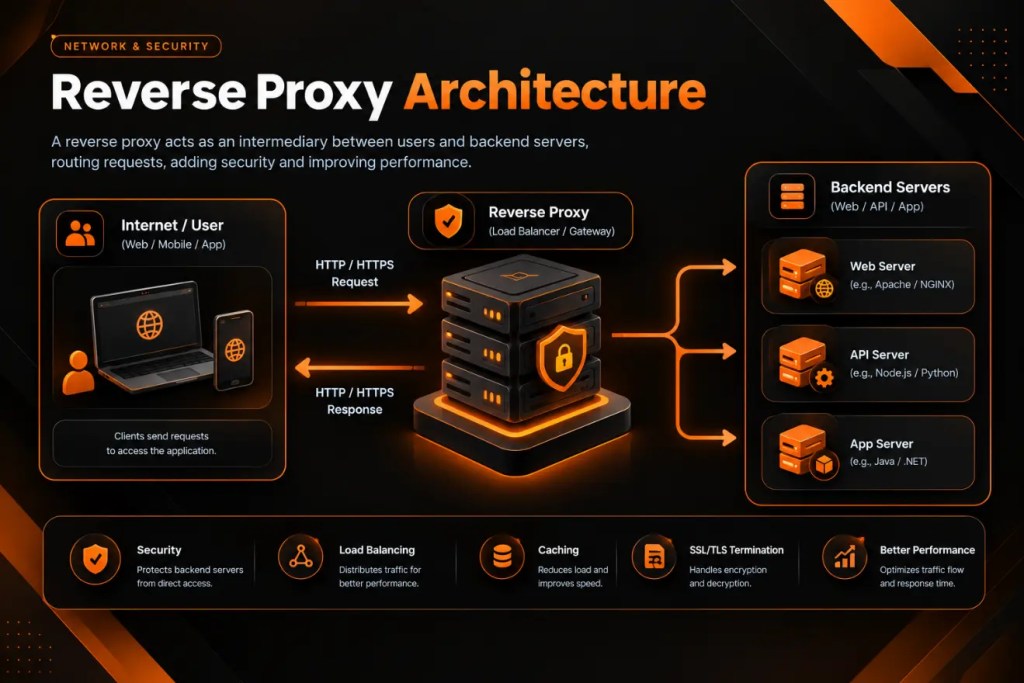
This approach is convenient since users only need to engage with a single public access point. Behind that entry point, the proxy can route traffic to many services.
For example, /server may redirect to a web hosting page, but /api leads to an API server.
What Happens to the Client’s IP Address?
A reverse proxy can send the client’s IP address information about the original client using headers like X-Forwarded-For. Backend programs can utilize this data to make logging, access control, analytics, and security decisions.
However, applications should only rely on transmitted client-IP headers from recognized and trusted proxy systems.
Correct handling is important since trusting an unverified forwarded IP might generate security and logging issues.
After learning what is a reverse proxy, let’s understand what does it actually do.
What Does a Reverse Proxy Do?
Depending on the software and configurations, a reverse proxy can handle a variety of traffic control functions. Routing, load balancing, caching, TLS handling, and traffic filtering are among the most frequently used capabilities.
Request Routing
Request routing directs consumers to the correct application or backend service. For example, a proxy may route requests for /dedicatedserver to one server and /api to another. This is particularly beneficial when several apps share a single domain.
Load Balancing
Reverse proxy load balancing spreads incoming requests among different backend servers. In this way, reverse proxies can redirect Hypertext Transfer Protocol (HTTP) sessions anywhere, and however they see fit.
In this approach, the reverse proxy may be utilized to distribute load in a way that optimizes the end user experience. Load balancing creates a more efficient and usable network. It may keep web servers from becoming overloaded, reducing the number of bottlenecks a site faces and ensuring better performance.
Caching
Reverse proxy caching enables the proxy to cache appropriate replies temporarily. Without a reverse proxy, backend servers may have to handle all caching. However, using a cache, the reverse proxy can take on the caching tasks.
Because the cache is immediately available to the end user, their material will load much faster than if the request needed to go all the way through to the origin server and back. This is an important function that you must know if you want to fully understand what is a reverse proxy.
SSL/TLS Termination
With reverse proxy SSL termination, the proxy manages the public HTTPS connection before delivering the request to the backend.
This allows for central certificate and SSL/TLS administration, rather than having each backend server handle the public TLS connection independently. As part of this arrangement, reverse proxy software can handle HTTPS and TLS.
The connection between the proxy and the backend can also be encrypted if the application demands it.
Security And Traffic Filtering
A reverse proxy can serve as a point of control for security measures.
Depending on the implementation, this might involve:
- Access Controls
- Rate limiting
- Request Filtering
- Web application firewall feature
- DDoS protection
- Authentication controls
The above-mentioned functions/features are not automated. They are determined by the proxy, service, and configuration you select.
Also Read: VPN vs Proxy: Which One Should You Use?
Benefits of Using a Reverse Proxy

The major reverse proxy benefits derive from putting one controlled traffic layer between the clients and backend systems. It can surely make different apps easier to scale, protect, and manage.
Key reverse proxy benefits include:
- Better scalability: Traffic may be distributed over several backend servers.
- Higher availability: Requests can be routed to available backend resources.
- Centralized traffic management: It allows you to handle routing and traffic rules all in one location.
- Reduced backend exposure: Backend addresses may not always need to be visible to users.
- Better performance: Caching can minimize the number of repeated requests to origin servers, resulting in improved speed.
- Centralized TLS: The proxy may manage certificates and public HTTPS connections.
- Simpler service management: Multiple apps can share a single public entry point.
As a result, understanding what is a reverse proxy involves more than just defining it. It also addresses how modern apps handle traffic between users and their backend infrastructure.
Common Reverse Proxy Use Cases
The most popular and common reverse proxy use cases include websites and apps that need better traffic control when traffic spikes occur, multiple backend services, easier scaling, and stronger protection.
High-Traffic Websites
A reverse proxy can help a busy website disperse incoming requests over many backend servers. This prevents a single server from handling all requests and makes it easy to increase capacity as demand grows.
Web Applications and APIs
Web applications frequently have separate frontend, backend, and API services. A reverse proxy can redirect requests to the appropriate service while providing users with a single domain and entry point.
Microservices and Containerized Applications
Modern web applications may have a large number of tiny services operating in containers. A proxy can redirect requests to the appropriate service depending on hostname or domain name, URL path, or other request parameters. This makes it valuable in containerized and microservice contexts.
Security and Origin Protection
A reverse proxy protects against direct assaults by masking the IP address and other identifying information of the origin server. Malicious actors will have a more difficult time exploiting server vulnerabilities.
Content Delivery and Caching
By caching static data like images, CSS, and JavaScript files, reverse proxies help to reduce the burden on the source server and increase site load speeds for end consumers. Reverse-proxy architecture is used in CDNs and edge devices or platforms. A request can first reach an edge server, which may deliver cached content or redirect the request to the origin if necessary.
Reverse Proxy vs Forward Proxy
The main difference is that a reverse proxy represents backend servers, while a forward proxy represents clients. Therefore, the major distinction is about who the proxy represents.
Follow the table below to find the key difference between understanding what is a reverse proxy vs forward proxy is:
| Feature | Reverse Proxy | Forward Proxy |
|---|---|---|
| Represents | Servers | Clients |
| Positioned In Front Of | Backend Servers | Client Devices |
| Main Purpose | Accept inbound application traffic and route it to backends. | Manages clients’ outbound traffic to the Internet. |
| Hides | Backend Infrastructure | Client identity/network |
| Traffic Direction | Incoming | Outgoing |
| Common Uses | Routing, TLS, caching, load balancing | Access control, filtering, privacy |
| Managed By | Server/application operator | Client/network operator |
| Typical Users | Businesses or web applications | Individuals or Corporate networks |
In basic terms, a forward proxy enables clients to access external services, whereas a reverse proxy helps external users access backend services.
Also Read: Using Proxy Server: 11 Advantages You Can’t Ignore
Reverse Proxy vs Load Balancer
These two technologies are frequently considered synonymous. In reality, each serves a separate purpose and has its own set of use cases. Here is a brief summary of each:
- Reverse proxies: They are server-side tools that handle inbound traffic to improve security, performance, and load distribution.
- Load balancer: While reverse proxies can assist in load distribution, load balancers specialize in it. They transmit traffic more effectively between servers, but lack the extensive security and caching capabilities of a complete reverse proxy.
For example, a reverse proxy can sit in front of a single backend server and manage TLS, routing, caching, and security. On the other hand, load balancing is defined as the main distribution of user requests across multiple resources.
Modern application delivery systems can incorporate both roles into a single platform. Therefore, you must know what is a reverse proxy deeply.
Popular Reverse Proxy Software and Services
Popular reverse proxy software and services include NGINX, Apache, HAProxy, Traefik, Envoy, and Cloudflare reverse proxy. However, there is no ultimate “best” reverse proxy. Choosing the best option solely depends on your overall traffic, key features, and management requirements.
For your reference, you can analyze the table below and find out which reverse proxy software and service fit best for your use:
| Solution | Common Use |
|---|---|
| NGINX | Reverse proxy, web serving, caching, load balancing |
| HAProxy | High-performance proxying and load balancing |
| Apache HTTP Server | Reverse proxy via proxy modules |
| Traefik | Containers and cloud-native environments |
| Envoy | Distributed and microservices architectures |
| Cloudflare | Managed edge reverse-proxy architecture |
For example, popular implementations of NGINX reverse proxy are used for web traffic, caching and load balancing.
An Apache reverse proxy may be set up using Apache’s mod_proxy modules.
When proxying is enabled, a Cloudflare reverse proxy routes HTTP and HTTPS traffic through Cloudflare’s network before delivering it to the configured origin.
Reverse Proxy Example
A basic reverse proxy example is a business that has a website and an API on separate servers. Instead of assigning users different public addresses, the corporation can deploy both services behind a single reverse proxy.
For example, when a user visits the main website (www.example.com), the proxy sends that request to the frontend servers.
When the same user calls /api/ (example.com/api/), the proxy then sends that request to API servers instead of frontend servers.
The user is now seeing the only public website, while the reverse proxy is handling the routing behind the scenes.
This is one of the easiest ways to understand what is a reverse proxy and how does it work in a real web application.
Are Reverse Proxies Secure?

A reverse proxy can help enhance an application’s security architecture, but it does not guarantee security.
A reverse proxy may support:
Backend or origin protection
- WAF Integration
- DDoS mitigation
- Rate limiting
- Access Controls
- TLS termination
- Request Filtering
For example, a managed reverse-proxy service may conceal the origin IP address and analyze traffic before passing requests to the application.
However, configuration is still important.
Incorrect forwarded-header settings might result in IP-related issues. Weak TLS configurations can degrade connection security. An unintentionally revealed origin can potentially enable users to circumvent the proxy.
As a result, reverse proxy security is ultimately dependent on both the proxy and its configuration.
When Should You Use a Reverse Proxy?
A reverse proxy is useful when your application requires a centralized layer for routing, encryption, security, caching, TLS, or traffic management. A tiny website running on a single server may not require a separate controlled proxy layer.
A reverse proxy can be useful in the following situations:
- Put many services behind a single public endpoint.
- Route traffic between apps.
- Balance traffic amongst backend servers.
- Centralize TLS management.
- Add caching.
- Implement centralized server security
- Protect the backend or origin infrastructure.
- Scale a program to several servers.
As your application expands, having a single traffic layer might make infrastructure more manageable. Before selecting when you should use it, you must first understand what is a reverse proxy.
Frequently Asked Questions (FAQs)
What is the purpose of a reverse proxy?
The main purpose of a reverse proxy is to receive multiple user requests on behalf of the backend servers and send those requests to their suitable locations. Other purposes include routing, caching, load balancing, security handling, and TLS controls.
What is the difference between a proxy and a reverse proxy?
A proxy server (or forward proxy) resides between client devices and the internet, acting on behalf of users. Reverse proxies are different. They sit between the internet and backend servers, acting on behalf of websites or apps.
Is Cloudflare just a reverse proxy?
No, Cloudflare is not just a reverse proxy because it offers many cloud-related services. However, it can also act like a universal reverse proxy only when you turn on its proxy feature.
Can a reverse proxy be hacked?
Yes, it is possible to hack a reverse proxy. It can usually be hacked through software vulnerabilities, misconfiguration, or by cyber-attackers who route traffic through spammy proxy configurations. A properly protected reverse proxy, on the other hand, can provide valuable security by filtering traffic, restricting requests, managing TLS, and reducing direct access to backend servers.
Conclusion
Reverse proxies are not just for the tech giants. Any site or app that needs higher performance, better security, and tighter control over resources will benefit. From small-scale bloggers to enterprise-level system managers, reverse proxies can be used to balance traffic flows, prevent fraudulent requests, and accelerate load times of a site.
If your application runs numerous services, receives a lot of traffic, requires centralized security, or has to grow across multiple servers, a reverse proxy might be an important aspect of the design. However, a basic website on a single server may not require the additional layer.
In this blog, we’ve learned what is a reverse proxy, how does it works, its benefits, its comparison with forward proxies, and much more.